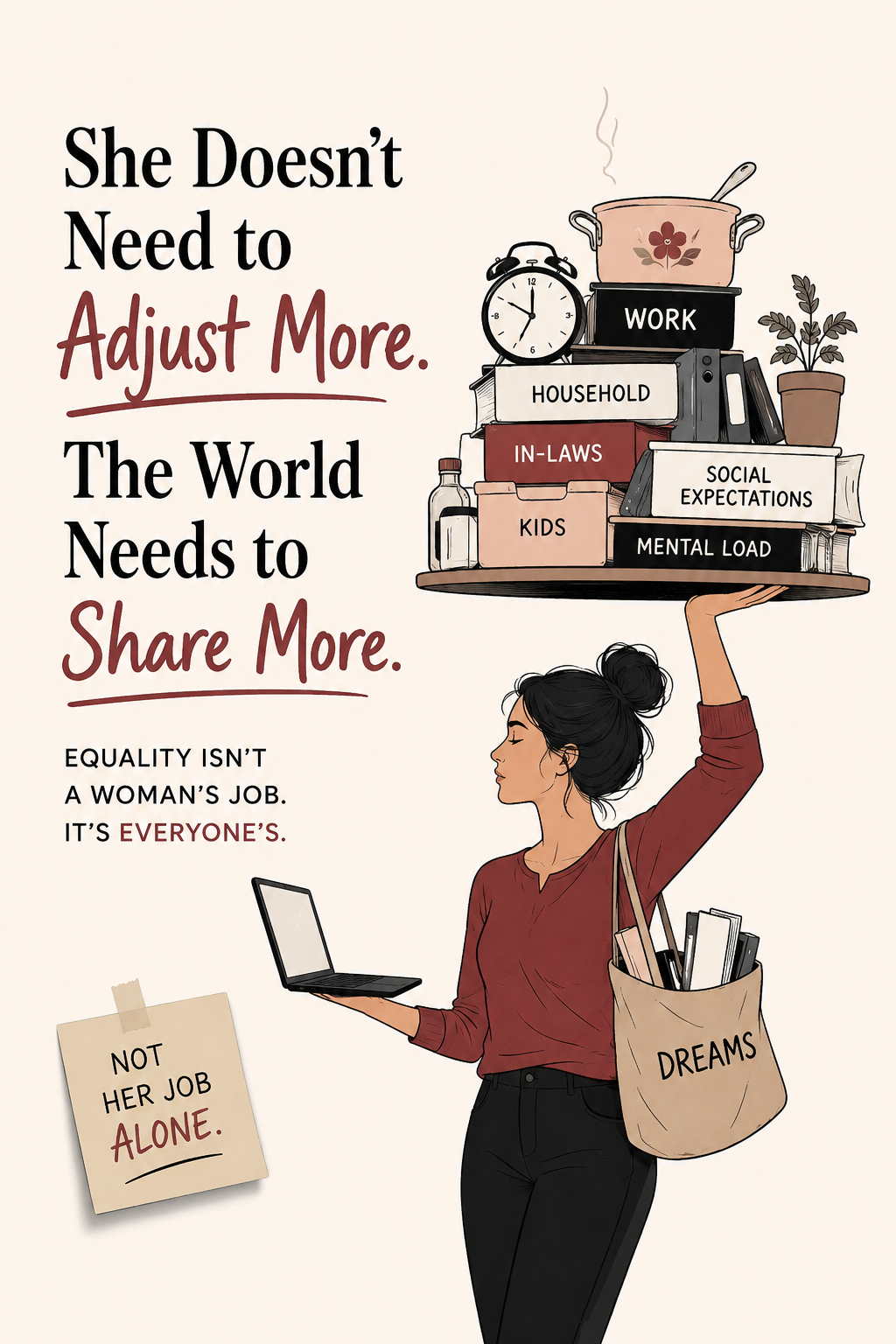
Why Women Are Still Expected to Adjust More Than Men
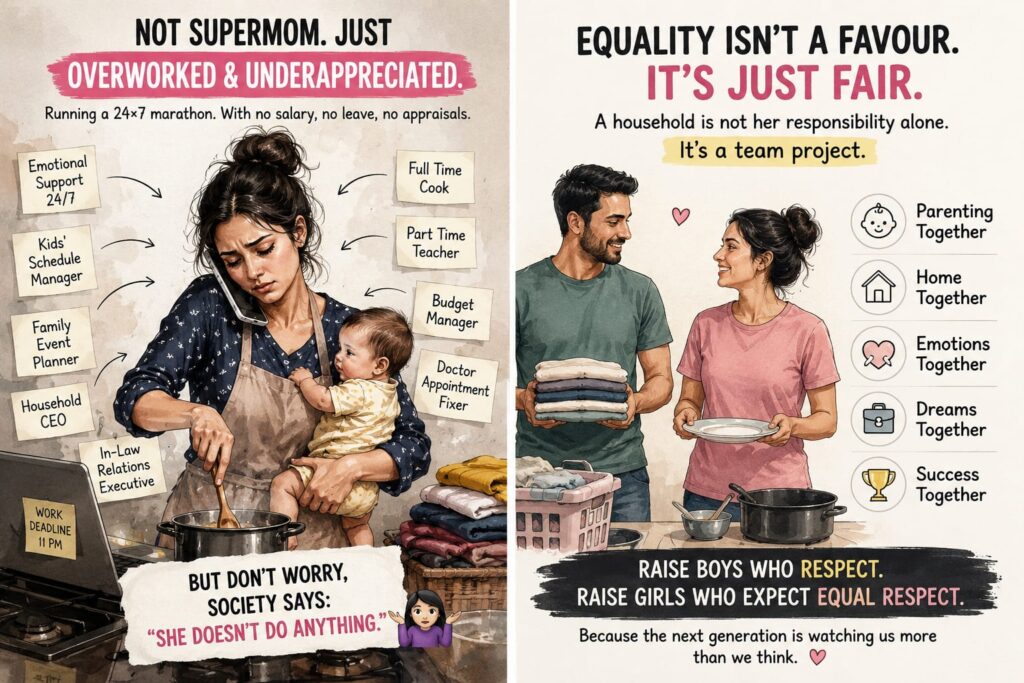
Research Shows the Pattern—And Even in 2026, It Hasn’t Fully Changed.
Decades of psychological and sociological research have consistently shown that girls are socialized differently from boys from a very early age. Studies on gender socialization reveal that girls are more often encouraged to be cooperative, nurturing, and emotionally aware, while boys are rewarded for independence, assertiveness, and risk-taking.
By the time children reach adolescence, these patterns are already deeply ingrained. Girls are more likely to take on caregiving roles, manage emotions within social groups, and prioritize harmony. Boys, on the other hand, are often given more freedom to explore, make mistakes, and focus on personal ambition.
Fast forward to adulthood, and these early lessons quietly shape expectations.
Even in 2026—an era of conversations about equality, empowerment, and progress—data still shows that women disproportionately carry the burden of unpaid labor, emotional management, and family adjustments. Whether it’s stepping back from careers after childbirth, relocating after marriage, or managing the invisible workload of households, the expectation remains subtly but persistently skewed.
For centuries, women have been told they are equal. Equal enough to study, equal enough to work, equal enough to earn… but somehow still expected to be the first ones to compromise when life gets inconvenient. Need someone to sacrifice their career after children? “She’ll understand.” Need someone to move into a new house after marriage? “She’ll adjust.” Need someone to remember birthdays, cook dinner, soothe family arguments, manage festivals, keep everyone’s emotions from exploding, and somehow smile while doing it? “Women are naturally good at these things.” Ah yes… “naturally.”
It’s fascinating how society keeps calling unpaid, exhausting, emotionally draining work a natural talent instead of what it actually is—work. And the funniest part? Many women don’t even question it anymore. Not because they’re weak. But because generations of conditioning have made extraordinary sacrifices look like ordinary responsibilities. When you’ve heard “good girls adjust” often enough, eventually adjustment stops feeling like a choice and starts feeling like your personality. This isn’t a blog about blaming men.
Nor is it about saying every woman has the same experience or every family works this way. This is about questioning a system that quietly teaches girls to shrink themselves while teaching boys the world will eventually make room for them. Because equality doesn’t disappear through dramatic speeches. Sometimes it disappears in tiny everyday moments. One compromise, One sacrifice, One dream postponed, One “it’s okay” at a time.
Society Doesn’t Ask Women to Adjust Anymore. It Just Makes Every Other Option Exhausting.
The funny thing is, society has become smarter. Nobody openly says, “Women shouldn’t have careers.” That would be too obvious. Instead, society created a much better strategy. It simply made chasing your dreams feel like running a marathon… while carrying groceries, a toddler, everyone’s emotions, and occasionally your husband’s missing socks. Technically, nobody stopped you. They just made the journey so ridiculously difficult that giving up starts looking like self-care.
Want to start a business? “Who’s looking after the house?”
Want to work late? “The children need you.”
Want to travel for work?“Family should come first.”
Want one quiet evening to yourself? “Wow… you’ve changed.”
It’s almost impressive. The barriers aren’t locked doors anymore. They’re tiny daily speed bumps placed so frequently that eventually you stop driving. Society then smiles proudly and says,
“See? It was her choice.”
What a masterpiece of psychological marketing.
The Invisible Tax Women Pay for Having Ambition
Every dream has a price. For many men, that price is usually hard work. For many women, it’s hard work… plus guilt. Somehow wanting something for yourself comes with a complimentary emotional invoice.
Take a promotion? “Will your family suffer?”
Hire help? “A real mother wouldn’t need that.
” Spend money on your own hobby? “Is that really necessary?”
Meanwhile nobody asks a father buying a ₹1 lakh motorcycle,
“But who will emotionally support the children while you’re riding?” Curious.
Women are expected to earn like they don’t have children……and parent like they don’t have careers. It’s basically two full-time jobs stitched together with coffee and silent panic.
The Most Dangerous Sentence Society Ever Invented
“I’m just a housewife.”
Read that again. Just…?
As if running an entire household, managing children, planning meals, remembering birthdays, buying groceries, keeping track of medicines, resolving family drama, handling festivals, and making sure everyone else functions somehow qualifies as…nothing. The tragedy isn’t that homemakers don’t work. The tragedy is that we’ve become so used to their work that we stopped calling it work. And here’s the part nobody likes talking about. There is absolutely nothing wrong with choosing to stay home…..Nothing. If raising children, managing a home, and building a family is genuinely your dream, that’s a beautiful choice. The problem begins when it’s no longer a choice.
When a woman quietly buries her ambitions because every path back to work feels blocked. When years of unpaid care leave her financially dependent. When she starts believing she “does nothing” simply because society refuses to value everything she does. The cure isn’t forcing every woman into an office.
The cure is making sure every woman actually has a choice. A choice she can make without guilt. Without pressure. Without being treated like she’s failing someone either way. Because equality isn’t telling women what they should become. It’s letting them decide who they want to become—and respecting that decision either way.
“She Doesn’t Work.” A Misconception That Undervalues Essential Contributions
Ah yes, the classic classification of work: The kind that earns a paycheck, And the kind that apparently earns… absolutely nothing but the smooth functioning of an entire household. Fascinating system. Somewhere along the way, we collectively decided that if money doesn’t land in your bank account every month, your efforts must be more of a hobby than actual work. Because obviously, if it’s not invoiced, it doesn’t count. Right? This charming little narrative has gifted us the ever-so-casual phrase: “She stays at home.”
As if she’s been lounging on a chaise longue all day, sipping tea and contemplating the meaning of life. Meanwhile, reality is quietly rolling its eyes. Even Indian courts—yes, actual courts dealing with actual legal matters—have had to step in and say, “Perhaps we should acknowledge that running a household and raising humans is, in fact, work.” They’ve gone so far as to assign monetary value to homemakers’ contributions, calling them the backbone of families and even “nation builders.” Imagine that. The judiciary gets it, but dinner table conversations still don’t. Because this isn’t just about cooking and cleaning—though, let’s be honest, those alone could qualify as full-time jobs with overtime. The real cost is what gets quietly shelved. Years, sometimes decades, of potential. Careers paused. Promotions declined. Degrees postponed. Businesses never started. Dreams politely told, “Maybe later.” if i could put a speaker on this blog page to say this out loud I colud have done.
And for those who dare to attempt both career and family? Congratulations, you’ve unlocked expert mode. Wake up earlier, Sleep later, Excel at work, Excel at home and top of that Smile through it all. And don’t forget, no bonuses for emotional labor, no leave for burnout, and certainly no applause for keeping everything from falling apart. You’re expected to perform at work as if you have no family, and at home as if you have no job.
But sure, let’s ask, “How do you manage everything so well?” as if it’s a cute party trick. Eventually, that mythical “later” arrives. Children grow up. The chaos settles. And suddenly, there’s a quiet, unsettling question: Now what? Because while others were busy building resumes, networks, and financial independence, these women were building lives just not the kind that fits neatly into a LinkedIn profile.
And here’s where society performs its finest plot twist. After years of saying, “Family comes first,” it turns around and asks, “So… what have you been doing all this time?” The audacity is almost impressive. Now, they’re “too old.” Their career gaps are “concerning.” Technology has moved on. Employers want “recent experience.” Financial independence feels like a distant concept. It’s almost as if the system was designed to applaud sacrifice but just not reward it.
And then comes the quietest, most damaging part. The internal doubt. Not because these women lack ability—but because they’ve been conditioned to see themselves primarily as caregivers, not as individuals with their own ambitions. Because when your worth is constantly framed as sacrifice, it becomes difficult to remember that you were always capable of more. A society that truly values women wouldn’t just romanticize sacrifice. It would stop requiring it as the default setting.
Women’s Health: The Department Society Keeps Running on “We’ll Look Into It Later.”
If women had a superpower, it wouldn’t be multitasking. It would be functioning while their own body is staging a full-scale protest—with better attendance than most corporate meetings. Menstruation. Pregnancy. Childbirth. Postpartum recovery. Menopause. Hormonal changes. A lineup so intense it deserves its own action franchise. Apparently, society looked at this list and said, “You’ll be fine. Dinner’s at eight.”
Ah yes, the timeless medical advice of “walk it off, but make it domestic.” What’s even more remarkable is how normal we’ve made women ignoring their own health. She postpones the doctor’s appointment because the child has tuition. Delays the blood test because guests are coming. Ignores severe period pain because “it’s probably normal.” Lives with back pain for years because everyone else comes first. Basically, if self-neglect were an Olympic sport, women would have a gold medal and still apologize for winning it. Some women don’t delay treatment because they don’t care. They delay it because they’ve spent years believing their discomfort can wait. And unfortunately, medicine hasn’t always helped. For years, researchers haven’t done enough research on women’s health, leaving gaps in diagnosis and care—because apparently, half the population was considered a niche category. Which explains why many women hear: “It’s just stress.”“It’ll settle after marriage.” “It’s normal after childbirth.” “Everyone has painful periods.”
Translation: “We don’t know, but we’re confident you’ll survive.”
Medical gaslighting has entered the chat—and it brought a clipboard and zero accountability. Thankfully, however, the law is beginning to catch up with this long-ignored reality. In 2026, the Supreme Court of India recognised menstrual health as part of the fundamental rights to dignity, health, and education. The judgment acknowledged that something as natural as menstruation should never become a barrier to education, health, or opportunity and directed governments to strengthen menstrual hygiene facilities in schools. Finally, a plot twist where common sense makes a cameo.
Women’s health is not a secondary concern—it is central to the well-being of families, communities, and society as a whole, and it deserves attention, respect, and care without delay. Because “we’ll look into it later” is not a healthcare strategy—it’s just procrastination with a lab coat.
So… How Do We Fix a Problem That Has Been “Normal” for Generations?
Good news: society created this mess. Better news: society can also hit “undo.” No, not with inspirational quotes over sunsets. With actual, everyday choices. (Wild concept, I know.)
Start Raising Children, Not Gender Roles.
Teach daughters that ambition isn’t a personality flaw. Teach sons that empathy won’t cause system failure. A boy should know how to comfort a crying child. A girl should know she doesn’t need a permission slip to dream. Both should know how to cook. Both should know how to earn. Both should know how to apologize. Turns out, life skills don’t come with a “for men only” label.
Stop Praising Sacrifice More Than Happiness.
At some point, we started treating exhausted women like limited-edition collectibles.
“She never thinks about herself.” “She sacrificed everything.” “What a wonderful woman.”
Maybe…
Maybe we should stop applauding women for vanishing and start applauding them for actually existing. A woman shouldn’t have to prove her worth by how much of herself she can erase.
Stop Calling Everything a Woman’s Responsibility.
Children have two parents. (Plot twist.) A home belongs to everyone living in it. Emotional support is not a subscription service that comes free with being female. Partnership means sharing the invisible work too—not just “helping” when it’s convenient. Because you don’t “help” in your own life. You show up.
Make Career Breaks Less Punishing.
One of the biggest reasons many women don’t return to work isn’t a lack of talent. It’s a lack of doors being open. Governments, employers, and companies can fix this with returnship programs, flexible work, affordable childcare, and hiring practices that don’t treat career gaps like a criminal record. A résumé doesn’t lose value because someone spent time raising humans. That’s not a gap. That’s a masterclass in multitasking, crisis management, and patience. I wish someone on earth truly understand this.
And Finally… Ask Better Questions.
Instead of asking, “Who’s looking after the children?”
Ask,
“How can both parents chase their goals without losing their sanity?”
Instead of asking “Why is she working so much?”
Ask, “Why do we still assume she’s the default parent?”
Sometimes change doesn’t start with a revolution. Sometimes it starts with one slightly uncomfortable question at dinner.
What Can One Person Do?
You don’t need to fix society overnight. Just stop recycling the same outdated rules. If you’re a parent, don’t raise your daughter to adjust more than your son. If you’re a son, don’t wait for instructions. Notice things. Do things. Repeat. If you’re a husband, don’t “allow” your wife to follow her dreams. You’re not issuing permits—walk beside her. If you’re an employer, don’t treat a career break like a red flag. It’s often a badge of resilience. And if you’re a woman… Please stop apologizing for existing at full volume.
Your dreams are not luxury items you unlock after everyone else is satisfied.
The Bottom Line
A society doesn’t become progressive because women can do everything. It becomes progressive when women don’t have to. The goal was never to create endlessly adjustable women. The goal is to build a world where no one has to shrink just to keep the peace. Because equality isn’t about splitting the weight evenly. It’s about making sure no one is carrying it alone.
Thankfully, The Story Is Slowly Changing…
Now before the comment section warms up its keyboards….No, this isn’t a blog saying every family treats women this way. Because thankfully… The world is changing. Slowly. Painfully slowly. Like buffering on 2G internet. But it is changing. its taking generations to change..
Thankfully, not everyone got the old instruction manual.
More fathers are proudly teaching their daughters to ride bikes instead of teaching them to “sit properly.”
More husbands are introducing their wives as partners instead of unpaid event managers.
And here’s a well-deserved shout-out to Millennials and Gen Z.
You’re not perfect—far from it. But you’re quietly rewriting rules that previous generations rarely questioned.
More women are refusing to apologize for having careers, choosing not to marry, marrying later, seeking therapy, prioritizing their health, sharing financial responsibilities, and saying “no” without writing a five-page apology afterward.
At the same time, more men are learning that strength isn’t measured by how little emotion you show or how many household responsibilities you avoid. They’re changing diapers without expecting standing ovations, taking paternity leave because parenting is their job too, cooking dinner because they’re hungry—not because they’re “helping the wife”—and raising sons who know that respect, empathy, and emotional intelligence aren’t “women’s qualities.”
Turns out, breaking generational cycles is harder than forwarding WhatsApp advice. But thankfully… people are choosing the harder option. And that’s exactly how real change begins. More companies are offering flexible work and returnship programs for women restarting their careers. that is very rare. More men are taking paternity leave—not because they’re “helping” their wives, but because they’re parenting their own children.
Even courts across India have increasingly acknowledged that unpaid care work has real economic value instead of dismissing it as “doing nothing.” These aren’t miracles. They’re reminders. Reminders that traditions are created by people. Which means people can change them too. And maybe that’s the biggest lesson here. The opposite of adjustment isn’t rebellion. It’s partnership.
One Last Thing…
And before someone says, “You’re exaggerating.” Relax. This blog barely scratched the surface. We didn’t even get to the unsolicited beauty standards, the “smile more” committee, the safety calculations before stepping outside, the guilt for saying no, the judgment for saying yes, the career penalties of motherhood, or the fascinating phenomenon where a woman can be too ambitious, too emotional, too independent, and somehow not enough—all before lunch.
The funny part? You don’t even have to dig deep to find these issues. Just exist as a woman for five minutes. Statistically speaking, society will send you a survey you never signed up for. Apparently, even breathing comes with performance reviews. But that’s a conversation for another blog… or twenty.
The Last Word
For generations, women have been told they are the stronger gender because they can “handle everything.” Let’s be honest. That’s not a compliment. That’s unpaid overtime with emotional interest. Strength should never become an excuse to give someone more weight to carry. A truly progressive society won’t be the one where women prove they can do everything. It’ll be the one where they no longer have to. Maybe one day little girls won’t grow up hearing, “Learn to adjust.”
Maybe they’ll hear, “Learn to live the life you want.”
And little boys won’t grow up believing someone else will quietly manage the emotional side and chores of life for them. They’ll simply grow up learning that respect, responsibility, sacrifice, ambition, caregiving, and dreams belong to everyone. Because in the end, equality isn’t about making women more like men. Or making men more like women. It’s about making sure neither has to shrink so the other can stand taller.
Until then…
Society will continue proudly saying, “Men and women are equal.”…while quietly handing one of them a much heavier backpack. And somehow acting surprised when she’s tired.
What do you think? Have you seen this silent expectation of “adjustment” change over the years, or do you think society has simply found more modern ways to ask women to sacrifice? Let’s discuss it in the comments. We promise to read them—even if society still expects women to read the room first.
Great content! Keep up the good work!