The Modern Relationship Problem: Love, Gender Roles, Emotional Labour & Why We Keep Getting It Wrong
Apparently, relationships have been upgraded. We have dating apps, relationship podcasts, couples therapy, attachment styles, love languages, boundaries, red flags, green flags, beige flags, and approximately 47 strangers on the internet who can diagnose your entire marriage from a 12-second voice note and a blurry screenshot. And yet, people still get married and discover that “we’re partners” sometimes means one person handles the emotions, the planning, the children, the family diplomacy, and the household details, while the other handles the electricity bill and proudly calls this teamwork.

Modern relationships have better vocabulary than previous generations. That does not automatically mean they have better systems. We can name a boundary, identify an attachment style such as relationship, situationship, nanoship, textationship and 100 different types, and make a colour-coded relationship spreadsheet—and still reproduce the same old expectations underneath it all. Women can build careers. Men can talk about feelings.
Couples can split bills, share chores, and make decisions together. At least, that is what the brochure says. Underneath the glossy user interface, many families are still running surprisingly old software.
A boy may still learn that being a good man means being strong, useful, financially responsible, protective, and emotionally indestructible. A girl may still learn that being a good woman means being patient, accommodating, understanding, and exceptionally talented at adjusting without ever calling it sacrifice. Then these two people grow up, fall in love, move in together, or get married, and discover they brought two different instruction manuals to the same relationship. One thinks love means providing. The other thinks love means emotional presence. One says, “I work hard for us. What more do you want?” The other thinks, “I know you work hard. But when was the last time you asked how I actually am?”
Nobody has to be a villain for a relationship to become unequal. Sometimes nobody cheated. Nobody stopped loving anyone. Nobody dramatically walked into the rain with a suitcase. The conversations simply become shorter, the silences longer, and one person starts adjusting so often that compromise quietly turns into identity. That is the real question behind this debate: why are women still expected to adjust more than men in so many relationships, and what happens when both partners are carrying different kinds of pressure?
The answer is more complicated than “men are privileged” or “women are overworked.” Both statements can describe parts of reality. Neither explains the whole relationship. The deeper story is about gender roles, emotional labour, mental load, financial pressure, cultural expectations, and the strange human habit of calling something “normal” simply because we watched it happen for twenty years.
We might want to rewind the tape.
To the boy who was taught that being a man means never needing anything from anyone. To the girl who was taught that being a good woman means needing less so others can be comfortable. And to the relationship they eventually tried to build while both quietly wondering why love feels like work no one agreed to apply for. Because that’s where the real story begins. And unfortunately, no podcast episode can fix that in 45 minutes with a soothing voice and a discount code.
We Bring Our Childhood Into Relationships
Here’s the inconvenient part about modern relationships: you don’t actually enter one alone. You arrive with your childhood, your family, your culture, your insecurities, your ideas about love—and a surprisingly detailed collection of relationship rules nobody remembers teaching you. You know the ones. Only women can handle household chores and only men can go outside to earn.
Nobody usually sits you down at age seven and says, “Congratulations, today we’re beginning your lifelong training in gender roles.” It happens more subtly.
You watch who cooks, earns, Who makes the decisions. Who takes care of everyone when they’re sick. Who is allowed to be angry. Who is expected to remain calm. Who gets praised for being “responsible” and who gets praised for being “understanding.” Eventually, these things stop looking like choices. They start looking like normal relationships. And that’s the sneaky part about gender socialization: it doesn’t always arrive as a lecture. Sometimes it arrives as everyday life, repeated often enough that your brain quietly files it under This Is Just How Things Work.
Research on gender socialization has found that children can be guided toward different expectations for how boys and girls should behave, including through family and cultural influences. So when a grown man struggles to express vulnerability, or a woman automatically becomes the emotional manager of the relationship, the pattern may have started long before the couple met.
They may simply be performing roles they learned long before they met each other. And now comes the really interesting question: What exactly were they taught to become? Because somewhere along the way, one child may have learned that being a man means carrying the world without complaining. And another may have learned that being a good woman means making sure everyone else is comfortable while quietly carrying her own world. And when those two children grow up and fall in love…Well. The childhood lesson eventually gets a seat at the dinner table. Unfortunately, it does not bring snacks. It brings expectations.
When “Be a Man” Becomes a Lifetime of Emotional Suppression
Some boys don’t get a childhood so much as an early promotion. One day they’re playing with toys; the next, someone is casually informing them that they are “the man of the house.” Congratulations. No interview. No salary. No training. Just a lifetime subscription to responsibility, emotional repression, and the sacred belief that asking for help is apparently a software failure.
He learns early that a good man should be strong, independent, protective, financially responsible, and capable of handling problems without making everyone uncomfortable with unnecessary emotions. Need help? Figure it out. Scared? Don’t show it. Hurt? Walk it off. Crying? Absolutely not. We have apparently discovered the greatest threat to civilisation: a boy with functioning tear ducts.
The Fine Art of Teaching Women to Adjust
Women were not born knowing how to adjust. Society gave them a masterclass. It started innocently enough: “Girls should be understanding.” Then came “Good daughters don’t argue,” “Good wives adjust,” “Be patient,” “Keep the peace,” “What will people say?” and the legendary “You’re a woman, you have to compromise.” Somewhere along the way, adjustment stopped being an occasional act of love and became a full-time female personality trait.
The training began early. Girls were taught to help with household chores while boys were often allowed to “focus on their studies.” They learned to serve guests, care for younger siblings, understand everyone’s moods, maintain family harmony, and eventually manage a home—because apparently domestic competence is something women are born with, like eyelashes. A daughter learned that being “mature” meant swallowing her anger. A sister learned to give in. A wife learned to tolerate. A mother learned to put everyone first. And every stage came with the same beautifully packaged message: if you love your family, you will adjust.
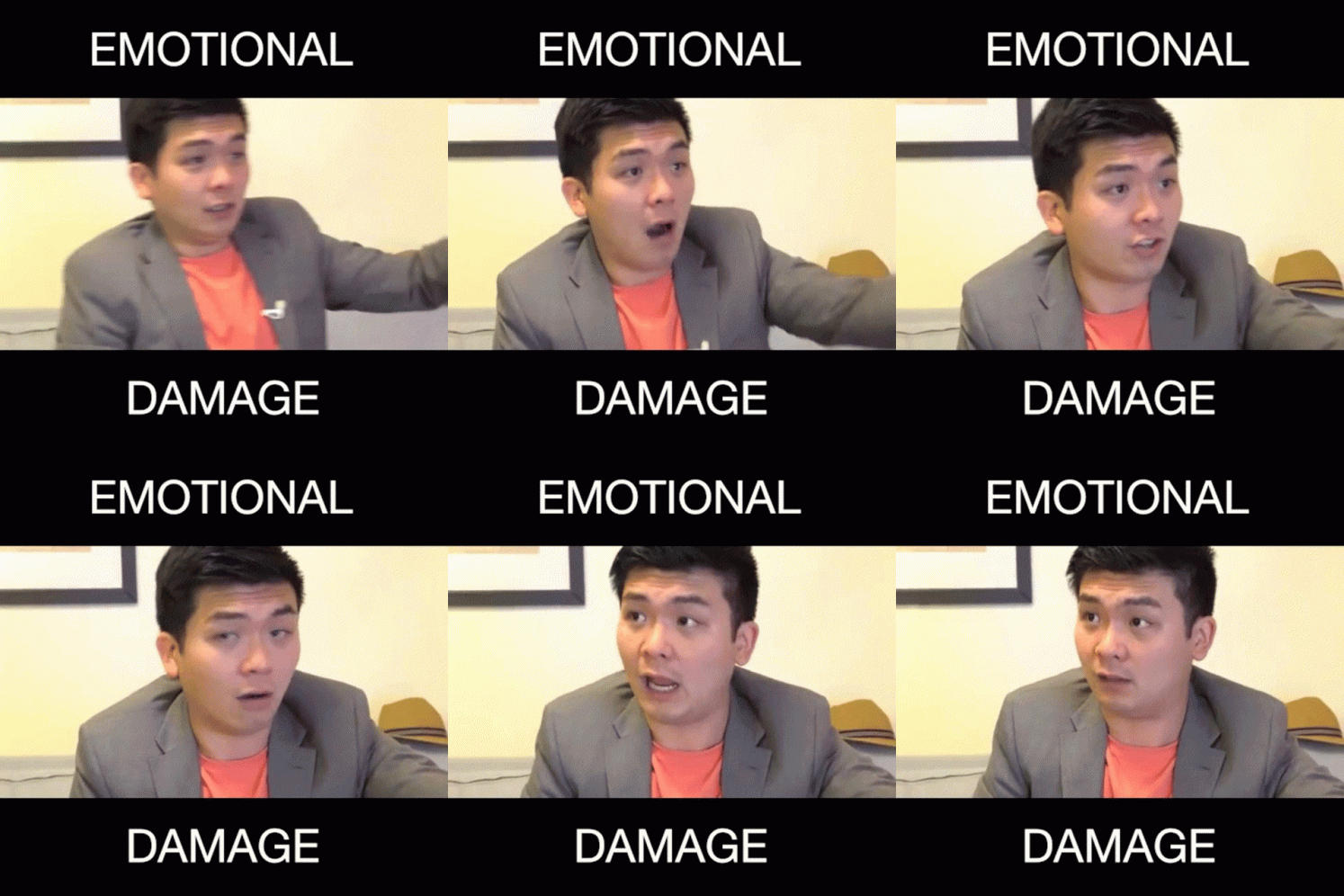
The problem wasn’t simply that girls were taught all these “life skills.” It was that boys were sitting right there, witnessing the same lessons, and somehow never got enrolled. Boys learned that the household would probably run itself. Truly, an impressive educational system.
And the numbers tell their own story. India’s 2024 Time Use Survey found that 81.5% of females participated in unpaid domestic services for household members, compared with 27.1% of males. Among participants, women spent an average of 289 minutes a day on those domestic services, compared with 88 minutes for men.
Culture made sure the lesson survived every generation. Movies romanticised the endlessly sacrificing woman. Families praised the daughter-in-law who “never complains.” Relatives treated a woman’s patience as proof of good character and her boundaries as evidence of attitude. A woman who stayed silent was sanskari. A woman who spoke up was difficult. A woman who tolerated everything was a good wife. A woman who demanded equal effort suddenly needed to be reminded that marriage is about compromise. Funny how compromise always seemed to arrive with her name already written on it.
Equality, But Please Don’t Get Too Comfortable
Then modernity arrived with a glossy new brochure called EQUALITY. Women were told they could study, work, earn, travel, have opinions, build careers, and make their own choices. And they absolutely can. But somewhere behind the shiny curtain, the old expectations quietly survived. She can work eight hours outside the home—but who is expected to remember what groceries are needed? She can earn money—but who is still expected to cook, clean, organise the children’s schedules, manage family relationships, host guests, plan holidays, check homework, care for ageing parents, and somehow remain emotionally available to everyone? Apparently, feminism upgraded the woman’s job description without always deleting the unpaid overtime.
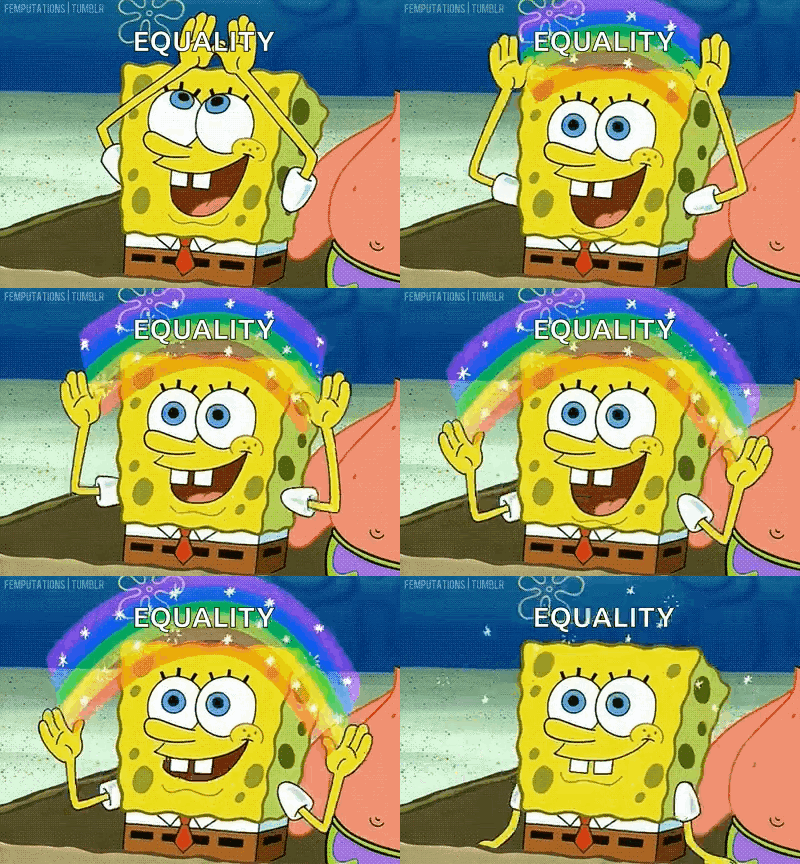
This is how women still adjust behind the curtain of equality. They adjust their careers around childcare, adjust their sleep around the household, adjust their clothes around relatives’ opinions, their ambitions around family expectations, their anger around everyone’s comfort, and their boundaries around the ancient question: “What will people say?” They may technically have the freedom to say no, but they are still socially trained to feel guilty when they do. They can have a career, but they are expected to make sure the family never feels the inconvenience of that career. They can be independent, provided their independence doesn’t become too inconvenient for anyone else.
And the cleverest part? Nobody has to explicitly order her to sacrifice anymore. Society has become much more sophisticated. Now it simply rewards her for doing it voluntarily. “She manages everything so beautifully.” “She is such an understanding wife.” “She never lets her family suffer because of her career.” Translation: she is carrying an unreasonable amount of responsibility so efficiently that everyone has forgotten to question why she has to carry it at all.
So when people ask why women are “expected to adjust more,” the answer isn’t that women are naturally more patient, nurturing, or self-sacrificing. It is that generations of culture, family expectations, gender roles, media, marriage traditions, and social conditioning trained them to associate love with accommodation and goodness with self-denial. Modern women may have gained the right to earn, speak, choose, and leave—but many are still expected to make everyone comfortable while doing it.
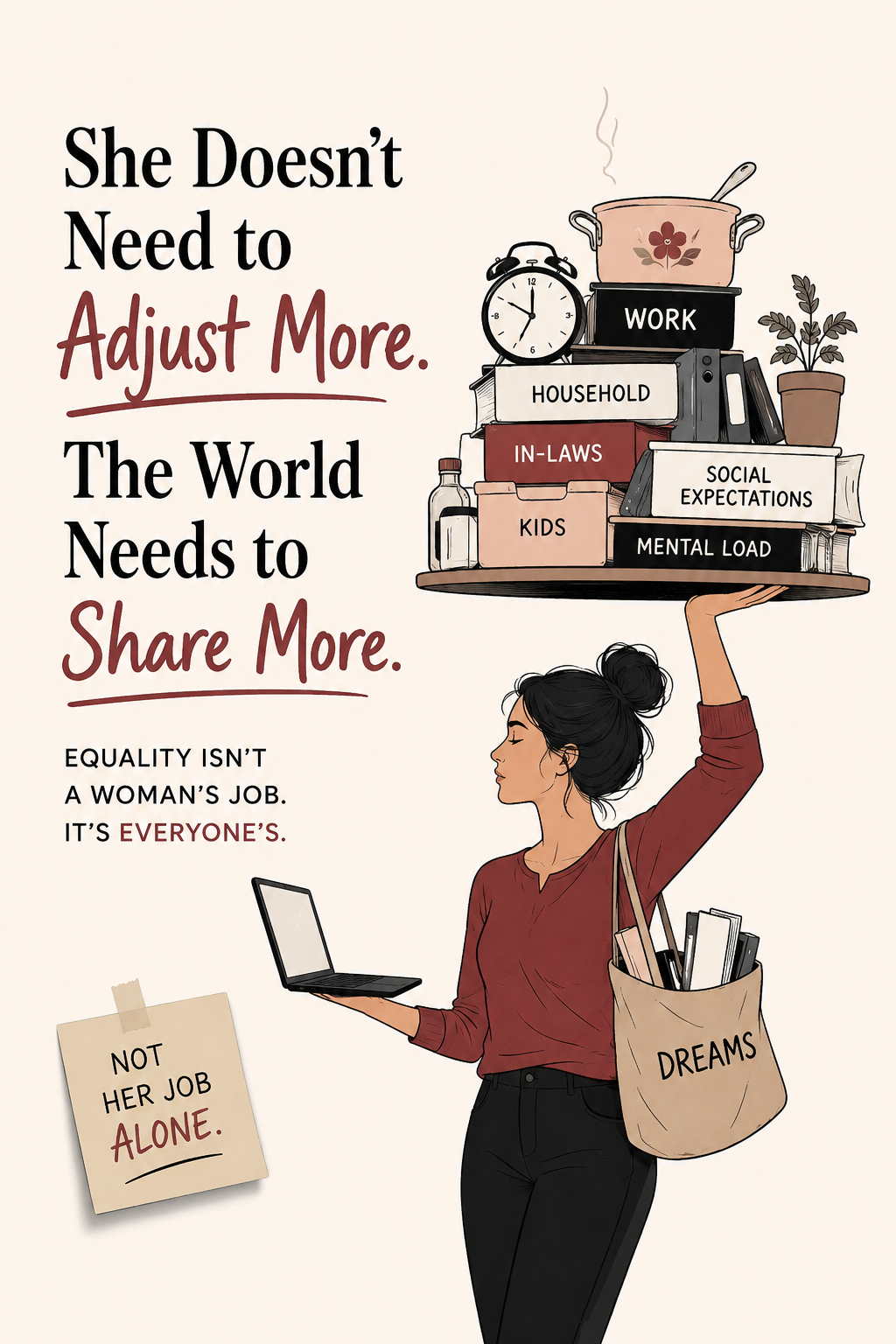
Equality gave women more doors. Society just forgot to stop handing them the house keys, the grocery list, the childcare schedule, and everyone’s emotional baggage on the way out. Because equality will never be truly equal if the solution is always asking her to adjust a little more. Maybe the real solution is simpler: she doesn’t need to adjust more—the world needs to share more.
Are Men Emotionally Struggling—or Just Conveniently “Bad at Feelings”?
And now, ladies and gentlemen, we arrive at the debate that has survived approximately every relationship argument since humans discovered texting: Do men genuinely struggle with emotional communication, or have some of them simply realised that saying “I’m just not good at feelings” is the relationship equivalent of a free trial with no cancellation button?
The prosecution has evidence. “He doesn’t communicate.” “He shuts down whenever we argue.” “He says he doesn’t know what he’s feeling.” “He can discuss cricket statistics for 45 minutes but suddenly develops a neurological condition when asked, ‘How did that make you feel?’” Suspicious. Very suspicious.
But then the defence enters the courtroom: “Your Honour, he was literally raised to believe emotions are a software bug.” And annoyingly… they have a point. Many men are socialised from childhood to value stoicism, independence, toughness, and emotional control. The American Psychological Association has discussed research connecting traditional masculinity norms with attitudes toward vulnerability and help-seeking. That context matters. So yes, some men genuinely struggle to identify, express, and regulate emotions.
But—and here’s where the jury collectively leans forward—struggling emotionally doesn’t give you a lifetime exemption from learning. If a man says, “I don’t know how to communicate my feelings,” fair. Learn. If he says, “I was never taught how to talk about emotions,” understandable. But if he has been told the same problem exists for five years, watched his partner repeatedly beg for basic emotional communication, and still responds with “That’s just how I am”? Sir. That is no longer a personality trait. That’s a subscription renewal.
Because there’s a difference between emotional difficulty and emotional irresponsibility. One means: “I genuinely don’t know how to do this, but I’m willing to figure it out.” The other means: “I know this hurts you, but changing would require effort, so perhaps you could simply lower your expectations.”
And let’s be fair: women can absolutely pull the same stunt. Being emotionally expressive doesn’t automatically make someone emotionally mature. A woman can communicate her feelings beautifully and still use them as ammunition. A man can struggle to articulate his emotions and still be deeply caring, self-aware, and willing to improve.
So the real question isn’t “Are men emotionally unavailable?” Nor is it “Are women asking for too much?” The better question is: What happens after someone realises they have an emotional weakness?

Because nobody gets to choose the emotional operating system they were handed as a child. But adults do get some say in whether they ever install the update. And that is where emotional intelligence, healthy communication, and emotional availability in relationships stop being “women’s expectations” or “men’s natural abilities.” They become basic relationship skills.
Because honestly, “That’s just how men are” stopped being a defence somewhere around the invention of Google. You can learn Excel. You can learn coding. You can learn how to reverse a car into a parking spot while pretending the three people watching aren’t judging you. You can learn an entire fantasy football league’s statistics. But apparently learning to say “I’m hurt, and I don’t know how to talk about it” is where civilisation must draw the line? Please.
The verdict is complicated. Some men are struggling. Some men are avoiding. Some men are doing both. And some have genuinely never been taught how to process emotions in the first place. Understanding that difference matters because explaining emotional unavailability is not the same as excusing it.
And that’s where the conversation gets even messier. Because if men were taught not to feel… who taught women that they were responsible for feeling everything for everyone?
Women Adjust, Men adjust too. So Who Is Actually Winning?
Here’s the plot twist nobody likes: men adjust too. Just differently.
A man may have the “privilege” of earning and making certain decisions that women in many families still have to fight for—but that doesn’t mean he gets a VIP pass to happiness. He may abandon a dream because someone has to provide. He may work so relentlessly that his own ambitions, hobbies and even basic free time become luxury items. And after being told his entire life to “be a man,” he may reach adulthood with the emotional vocabulary of a Wi-Fi router. Men are buried under the expectation to provide, carry responsibility, and keep going without complaining. They rarely express the weight of it because, well, they are men—and apparently men are supposed to struggle silently. Because of that pressure, some men may even give up on their dreams, goals, and ambitions to fulfil the responsibilities placed on their shoulders.
Meanwhile, women have been doing their own Olympic-level adjustment: fighting for the basic right to study, work, travel, earn, make decisions—and then coming home to discover that apparently equality ends at the kitchen door. In India’s 2024 Time Use Survey, women participants spent an average of 289 minutes a day on unpaid domestic services for household members, compared with 88 minutes for men. So yes, men are fighting too. Women are fighting too. The difference is often what they’re fighting against.
Basically, both genders received a different version of the same terrible deal. And perhaps the goal of the next generation shouldn’t be deciding who suffered more. It should be making sure their children don’t have to suffer in the same categories at all.
Because imagine a future where a man can say, “I need help,” without feeling emasculated—and a woman can say, “I want this,” without needing permission. Radical stuff. Or, hopefully, just normal life.
How Gender Roles Can Turn Ordinary Conflict Into Relationship Betrayal
Betrayal is not always a dramatic affair, a secret phone, or a cinematic confession in the rain. Sometimes betrayal grows more quietly: repeated dismissal, broken trust, emotional neglect, chronic lying, financial secrecy, contempt, or the slow realisation that your partner has stopped treating your needs as real.
That matters because unequal relationship roles can create the conditions in which resentment grows. One partner keeps adjusting. The other keeps assuming the adjustment is normal. One person feels unseen. The other believes providing or staying physically present should automatically count as emotional closeness.
Then the relationship develops a dangerous gap between what one partner thinks they are giving and what the other partner experiences as receiving. That gap does not excuse betrayal. It helps explain why emotional disconnection can become fertile ground for serious relationship betrayal.
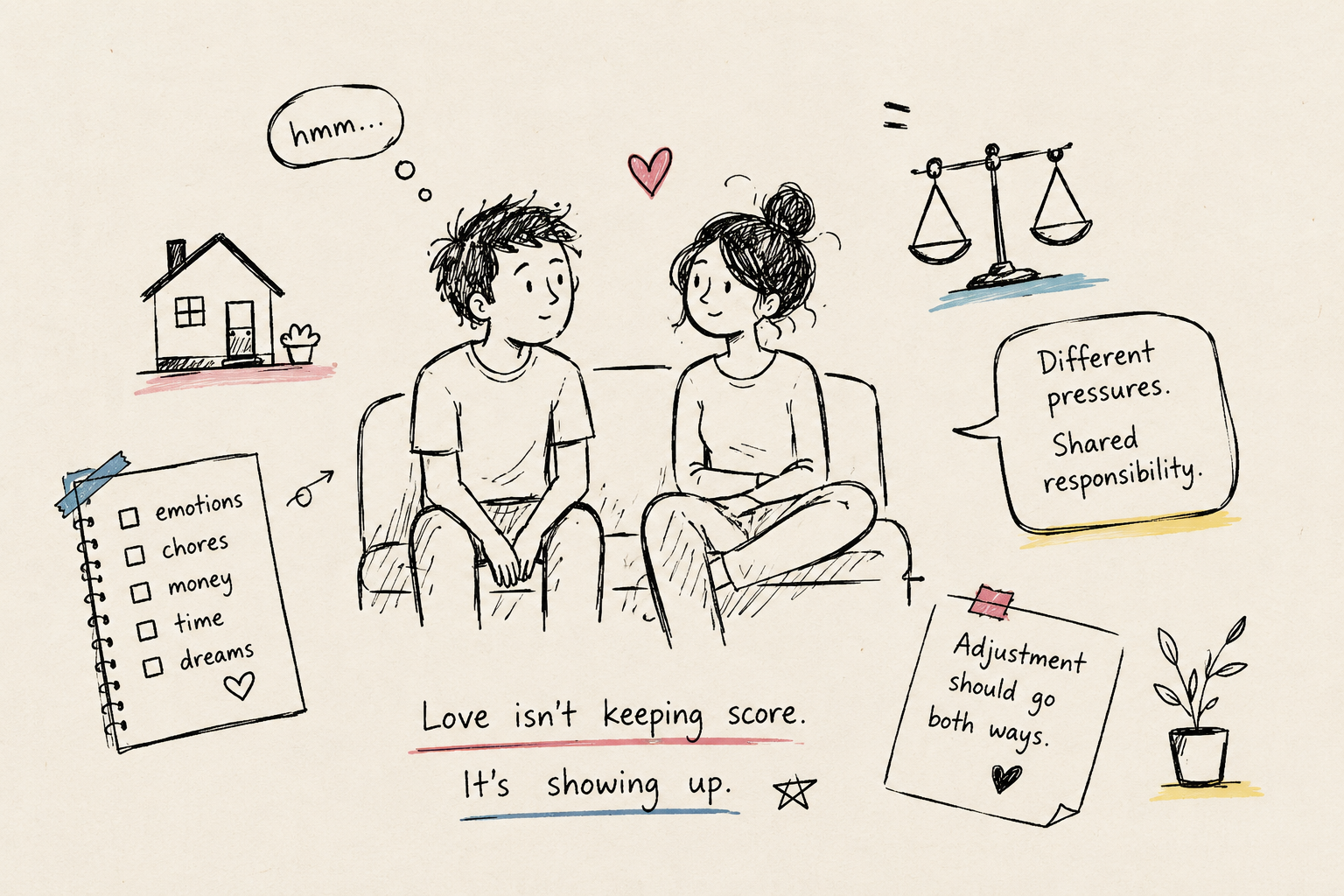
What Does a Healthy Relationship Actually Look Like?
After all this discussion about gender roles, emotional labour, relationship expectations and unequal adjustment, you might reasonably ask: Okay, genius. What are we actually supposed to do about it?
First, stop treating relationships like a gender-based job description. Men don’t need to be emotionless ATMs with a protective instinct, and women don’t need to be unpaid therapists with a lifetime membership to the Department of Adjustment.
What Men Need to Unlearn
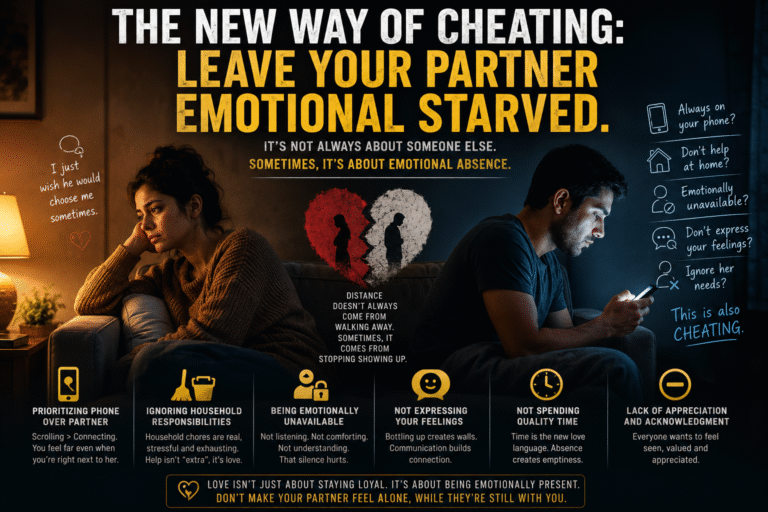
Being a provider is valuable. Being emotionally unavailable isn’t. Men need to learn that communication, emotional availability, household responsibility and vulnerability are relationship skills, not optional accessories that come free with marriage. You don’t get bonus husband points for paying the electricity bill if your partner is emotionally starving beside you.
What Women Need to Unlearn
Being understanding is beautiful. Being permanently responsible for everyone’s comfort? That’s unpaid emotional labour wearing a cute outfit. Women don’t have to prove they’re good partners by endlessly adjusting, swallowing resentment or becoming the relationship’s full-time customer-support department.
What Both Partners Need to Learn
A healthy relationship should feel less like “What am I getting?” and more like “What are we building?” Listen without preparing your defence. Communicate before resentment becomes a personality. Share household work without waiting for instructions. Respect each other’s careers, time, and ambitions. Make decisions together. Apologise without attaching a 14-slide PowerPoint explaining why you were technically right. And when one person is struggling, the other doesn’t immediately start calculating whose turn it is to suffer.
Healthy relationships depend heavily on open communication, constructive conflict, listening, and making space for deeper conversations—not merely managing bills and household logistics. (American Psychological Association)
And thankfully, the definition of partnership is changing. Not completely. Not everywhere. And certainly not fast enough for everyone’s liking. But it’s changing. A younger generation is increasingly questioning the idea that a man provides while a woman adjusts and replacing it with something far more radical: two adults build a life together. Researchers have also described modern relationships as increasingly egalitarian, with partners seeking not just financial or household cooperation but emotional connection, personal growth, and shared power. (American Psychological Association)
Maybe future couples won’t be shocked by a man cooking dinner. Maybe a woman earning more won’t require a family emergency meeting. Maybe asking your husband to look after the children won’t be described as “helping his wife.” Maybe a wife having her own money, opinions, ambitions, and boundaries will be about as controversial as owning a toothbrush.
Because perhaps the healthiest relationship isn’t the one where nobody ever needs to adjust. It’s the one where both people adjust when necessary—and neither person is expected to disappear in the process.
The Real Meaning of Equality in Marriage and Long-Term Relationships
Equality is often misunderstood as identical contribution. But two people can contribute differently and still have an equal relationship. The more useful test is whether both people have comparable dignity, voice, agency, and responsibility for the life they are building.
One partner may earn more. The other may do more caregiving. One may be better at finances. The other may be better at emotional support. One may carry a heavier load for a season because the other is sick. None of that automatically makes the relationship unequal. The problem begins when a temporary difference becomes a permanent entitlement: “I earn, therefore I decide.” “I cook, therefore you owe me obedience.” “I am the emotional one, therefore you never have to learn.” “I am the provider, therefore my exhaustion matters more.”
Healthy partnership replaces entitlement with reciprocity. It asks: Are both people allowed to have needs? Are both people expected to contribute? Are both people heard? Are both people able to change?
We Don’t Need Better Husbands or Wives. We Need Better Partners.
Maybe that’s the whole problem with modern relationships: we’re still obsessing over how a good husband or good wife should behave instead of asking whether two people are actually being good partners. Because love isn’t supposed to be a daily audition for “Who sacrificed more?” Healthy relationships need communication, respect, shared responsibility, and the ability to actually listen when the other person says, “Something isn’t working.”
So perhaps the upgrade isn’t men vs. women, provider vs. adjuster, or 50/50 vs. 70/30. It’s simply this: You carry me when I can’t. I carry you when you can’t. We communicate before resentment files a permanent address. And honestly, revolutionary technology has been invented. It’s called being a decent partner.
Maybe the future of relationships isn’t about finding someone who perfectly fits an outdated role. Maybe it’s about finding—or becoming—someone who knows how to build the damn relationship with you. Maybe a woman earning more won’t require a family emergency meeting. Maybe asking your husband to look after the children won’t be described as “helping his wife.” Maybe a wife having her own money, opinions, ambitions, and boundaries will be about as controversial as owning a toothbrush.
And maybe one day, we’ll look back at today’s relationship arguments and wonder: “Wait… people actually thought that was a man’s job and that was a woman’s job?” That’s the real shift. The goal isn’t to create better husbands and better wives who perform their traditional roles more efficiently. It’s to create better partners. The kind who can say: “I don’t have to do everything for you. I just have to make sure I don’t make you carry everything alone.” Because perhaps the healthiest relationship isn’t the one where nobody ever needs to adjust. It’s the one where both people adjust when necessary—and neither person is expected to disappear in the process.
Mighty solution from trending talez
And no, the solution is not going to magically fix everything, because unfortunately, we have not yet invented a time machine that can travel back to childhood and confiscate every terrible piece of relationship advice a person was given at age seven. It cannot rewrite the boy who was taught that emotions are weakness or the girl who was taught that being a “good woman” means adjusting until she practically disappears. But it can help heal some of what those lessons created. So perhaps it is time we stop treating marriage like a two-hour event where everyone learns how to pose for photographs and nobody learns how to actually live together. Introduce a compulsory pre-marriage crash course for both men and women—not a cheesy seminar on how to keep your spouse happy, but an actual course on communication, emotional intelligence, conflict resolution, financial responsibility, household labour, mental load, boundaries, consent, expectations, parenting and, most importantly, how to be a partner rather than a gender-role employee. Because apparently we will happily demand a driving licence before someone is allowed behind the wheel, but when it comes to marriage, we just hand two emotionally undertrained adults a lifetime contract and say, “Congratulations. Figure it out.”
Frequently Asked Questions About Gender Roles and Adjustment in Relationships
Why are women expected to adjust more than men in relationships?
Because for generations, “good woman” has quietly been marketed as a synonym for “excellent at compromising.” In many traditional families, women have been expected to adapt to a husband’s family, career, location, household routines, caregiving responsibilities, and everyone else’s preferences. Social expectations, unequal domestic work, and cultural ideas about femininity keep reinforcing the pattern. Modern relationships are finally questioning the revolutionary concept that perhaps both people should adjust, instead of handing the adjustment department exclusively to the woman.
Do men also make sacrifices in relationships?
Absolutely. Men can face pressure to provide financially, suppress vulnerability, work excessively, give up personal goals, and carry the responsibility of being the family’s unofficial ATM, security system, and emergency helpline. Recognising those pressures doesn’t erase the domestic and emotional labour many women still carry. The goal isn’t to organise a misery Olympics and award a gold medal to whichever gender suffered more. The goal is to stop pretending either person’s burden is automatically their destiny.
What is emotional labour in a relationship?
Emotional labour is the invisible work of noticing feelings, maintaining emotional connection, initiating difficult conversations, comforting someone, anticipating needs, resolving tension, and basically keeping the relationship emotionally alive. Either partner can do it. The problem begins when one person automatically becomes the relationship’s unpaid emotional customer-service department, while the other simply shows up and asks why everything feels tense.
What is the mental load in marriage?
Mental load is the constant cognitive responsibility of planning, remembering, anticipating, organising, and keeping track of household and family life. You can technically “share chores” while one person still carries most of the mental load because they are the one who notices the groceries are finished, remembers the doctor’s appointment, plans the birthday, checks the school schedule, and then delegates everything. Congratulations, everyone helped—but apparently one person was still running the operating system.
Should a healthy relationship always be 50/50?
No. Healthy relationships aren’t mathematical equations where both people must contribute exactly 50% every Tuesday at 7 PM. Sometimes it is 50/50. Sometimes it’s 20/80 or 70/30 because of illness, pregnancy, parenting, career pressure, unemployment, grief, or simply because one person is having a terrible month. What matters is whether the imbalance is recognised, mutual, responsive, and capable of changing when circumstances change. The problem isn’t temporary imbalance. The problem is when 80/20 quietly becomes someone’s permanent job description.
Why do some men struggle to communicate their feelings?
Some men grow up hearing that toughness, independence, emotional control, and silence are signs of masculinity. Vulnerability can therefore feel unfamiliar or even threatening. So yes, some men genuinely struggle to identify, express, and communicate their emotions. But “I was never taught” explains the problem; it doesn’t automatically excuse never learning. Emotional communication is a skill, not a biological feature mysteriously missing from the male operating system.
How can couples share household and emotional responsibilities fairly?
Stop dividing only the visible chores and start dividing ownership. Who notices what needs to be done? Who plans it? Who actually does it? Who remembers to follow up? Who handles the emotional conversations, parenting decisions, household management, and family responsibilities? Fairness isn’t about keeping a spreadsheet and screaming, “I took the bins out twice!” It’s about making sure one person isn’t secretly managing the entire household while the other gets credit for occasionally participating. And because life changes, the arrangement should change too. A healthy relationship isn’t about finding the perfect 50/50 split; it’s about making sure neither person becomes the permanent unpaid manager of everything.
-Source note: India’s Time Use Survey 2024, Ministry of Statistics and Programme Implementation (MoSPI), Government of India. The article uses the official all-India figures for unpaid domestic services among persons aged 6 years and above: 81.5%
female participation versus 27.1% male participation; average time among participants: 289 minutes for females versus 88 minutes for males.
-Source note: American Psychological Association resources on men, masculinity, emotional expression and help-seeking were
used to support the discussion of how traditional masculine norms can affect vulnerability and help-seeking. The article
intentionally avoids treating all men as having the same emotional experience.