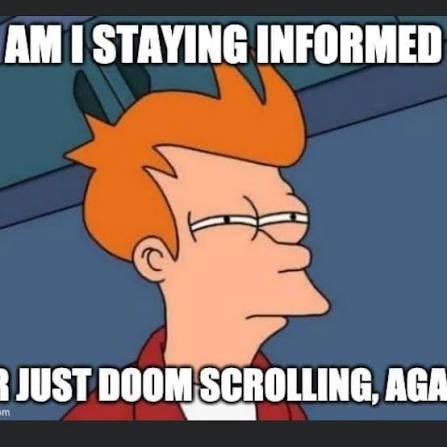
Doomscrolling and Mental Health: What You’re Actually Doing When You Can’t Stop Scrolling
When “Just Five Minutes” Turns Into an Anxiety Marathon..
It’s 11:47 PM. You put your phone on the nightstand, turn off the light, pull up the blanket and make a mature, responsible decision: “Tonight, I am getting eight hours of sleep.” Beautiful. Personal growth. Character development. Then a tiny thought appears: “Wait… did that completely unhinged argument on X ever get resolved?” Your hand reaches for the phone. You open one app. Forty-five minutes later, you are four years deep into a stranger’s comment history, consuming opinions from people you have never met about events you cannot control, while your eyeballs feel microwaved. You know more about a geopolitical crisis, celebrity breakup, financial panic and two influencers fighting over a sponsored handbag than anyone reasonably needs to know before midnight. And yet your thumb continues.
Swipe… Swipe… Swipe…
Welcome to doomscrolling, or, as we like to call it at Trending Talez: voluntary mental turbulence with Wi-Fi. Doomscrolling is repeatedly consuming negative, alarming or distressing online content long after you intended to stop. It can include negative news, social-media arguments, disasters, crime stories, political outrage, financial fears, health scares, celebrity drama, endless comment sections and breaking-news updates. Reading reliable news for 15 minutes and closing the app is not automatically doomscrolling. Doomscrolling happens when you keep consuming negative information even though you know it is making you feel worse. You are no longer asking, “What is happening?” You are asking, “What happens next?” And the internet has an unlimited supply of “next,” usually delivered by someone shouting into a ring light.
What Are You Actually Doing When You Doomscroll?
When you doomscroll, you are not simply “checking your phone.” That is the polite version you tell yourself so the behaviour sounds less embarrassing. You are repeatedly exposing your brain to danger, conflict, uncertainty and outrage while hoping the next post will somehow make you feel safer. You are searching for closure in a system designed to keep you alert and emotionally available to the next advertisement.
You read one alarming headline, search for context, read someone’s reaction, watch a video explaining the reaction, read comments arguing about the video and then find an unrelated disaster because the algorithm has decided your evening needs a broader theme. At some point, you are no longer gathering information. You are performing emotional surveillance on the entire planet from a horizontal position.
Your brain says, “I need to understand this so I can relax.” Your thumb replies, “Excellent. Let’s investigate 600 more posts.”
Why Can’t You Stop Doomscrolling?
Doomscrolling is often driven by a search for certainty. Something frightening happens and your brain says, “I need to understand this.” You search, then ask, “How bad is it?” You search again, followed by, “What happens next?” Soon, you are checking updates, reading comments and watching another video because you hope someone has finally explained everything. Suddenly, you are 73 posts deep, emotionally exhausted and somehow an expert on a situation that happened in a country you have never visited.
The internet rarely provides a final answer. There is always another update, prediction, argument, conspiracy or person confidently explaining something they learned 11 minutes ago. Your brain thinks, “If I know enough, I will feel safe.” The algorithm replies, “Wonderful. Here are 400 more things to worry about.”
Doomscrolling also creates the illusion of control. You cannot stop a war, fix the economy, settle a celebrity feud or personally discipline everyone spreading misinformation. But you can refresh the page, so you do, because pressing a tiny button apparently feels like civic participation.
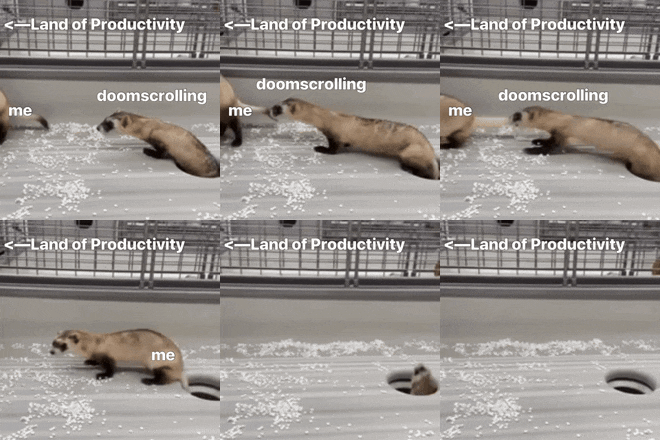
Who Is Responsible for Doomscrolling?
The uncomfortable answer is: you are responsible for your choices, but you are not solely responsible for the system designed to manipulate those choices. Technology companies build platforms around attention. Their business models depend on keeping you watching, clicking, reacting, sharing and returning. The longer you stay, the more advertisements you see and the more data you generate.
Algorithms learn what makes you angry, anxious, curious or emotionally invested, then serve you more of it. Not because they care about your mental health, but because your distress is apparently excellent for engagement metrics. Infinite scrolling removes natural stopping points, notifications interrupt silence, autoplay removes the need to choose and trending sections create artificial urgency. Recommendation systems quietly study your emotional weaknesses like an unpaid therapist with a marketing degree.
So yes, technology deserves a roast. Your phone is not a neutral little rectangle waiting for you to check the weather. It is connected to a global attention economy that would happily keep you awake until sunrise if that improved the quarterly report.
But you cannot defeat technology by yelling at it. You still need your phone for work, communication, banking, navigation and education. You cannot move to a forest and communicate through carrier pigeons every time an app annoys you. The goal is to understand the machine, create boundaries and stop volunteering your nervous system as its testing laboratory.
Doomscrolling, Anxiety and Mental Health
Doomscrolling and anxiety can reinforce each other. You may scroll because you feel anxious, but the negative content can increase stress, creating a cycle of anxiety, checking, disturbing information, more anxiety and more checking. You scroll for reassurance but often encounter more uncertainty, conflict and alarming information. It is basically emotional self-harm with a Wi-Fi connection, except you keep calling it “staying informed” so nobody asks questions.
Doomscrolling does not automatically cause an anxiety disorder or depression. However, problematic doomscrolling has been associated with anxiety, stress, psychological distress, depressive symptoms and poor sleep. People who already feel anxious may doomscroll more often, while doomscrolling and sleep deprivation can make distress worse.
The sensible conclusion is not that your phone personally caused your depression. It is that if scrolling consistently makes you anxious, exhausted or overwhelmed, your relationship with that content deserves attention. Your phone may not be the villain, but it is certainly enabling the plot, providing the soundtrack and collecting advertising data while you panic.
Why Your Brain Focuses on Negative News
Humans naturally pay attention to threats because identifying danger can help us respond. The problem begins when your smartphone delivers every alarming event happening around the world directly into your bedroom. Your brain evolved to notice danger in its environment. It did not evolve to process wars, disasters, political scandals, financial crashes, celebrity controversies and 900 strangers arguing about them before breakfast.
One frightening story can become a headline, video, reaction, commentary, Reddit thread, TikTok explanation, Instagram reel and argument-filled comment section. You did not just consume the event. You consumed its entire extended universe, including the spin-off nobody requested.
Social-media algorithms and infinite scrolling make this worse by removing natural stopping points. Every swipe promises that the next post might be more interesting, important or urgent than the last, keeping you engaged even when the content makes you feel worse. Your brain is screaming, “Please stop.” The algorithm is whispering, “But what if the next post finally fixes your life?”
The “Just Five Minutes” Doomscrolling Trap
Doomscrolling usually begins with, “I will only check for five minutes.” Five minutes becomes ten, then twenty, then thirty. Eventually, you think, “I have already wasted this much time, so I might as well keep going.” You are no longer scrolling because you want to. You are scrolling because stopping feels like admitting you wasted time. So you waste more.
This is how your phone turns five minutes into a full-length documentary about your own poor decisions. The worst part is that the documentary has no ending. Just autoplay.
Doomscrolling at Night and Sleep Problems
Night-time doomscrolling is especially harmful because it combines emotional stimulation with delayed bedtime. You are tired and your brain needs to wind down, but instead you feed it conflict, danger and uncertainty. At 11:30 PM, you plan to check the news. At 12:05 AM, you are reading reactions. At 1:07 AM, you are investigating the comments.
Your brain is no longer preparing for sleep. It is preparing for war, despite the fact that you are lying under a blanket wearing old sweatpants. Doomscrolling before bed can reduce sleep duration and make it harder to relax. Poor sleep may leave you tired, irritable and unable to concentrate the next day, increasing your reliance on your phone and continuing the cycle.
Then you spend the morning wondering why you feel terrible, as if your brain did not spend the night consuming disaster, outrage and strangers arguing about cryptocurrency.
How Doomscrolling Affects Mental Health
The effects vary, but common problems include:
Increased stress and anxiety — Your nervous system apparently needed a 2 AM briefing on every catastrophe currently trending.
Emotional exhaustion — You begin with one headline and end up carrying the internet’s emotional baggage upstairs.
Difficulty concentrating — Your attention span starts behaving like a browser with 46 tabs open and no idea where the music is coming from.
Poor sleep — You sacrifice rest to investigate people arguing online, then act surprised when your brain files a formal complaint.
Irritability — After absorbing hours of outrage, even someone chewing too loudly can feel like a declaration of war.
Feelings of helplessness — You consume problems from around the world while having no practical way to fix most of them from your bed.
Reduced productivity — Your to-do list remains untouched while your thumb earns an Olympic medal in refreshing.
Compulsive checking — You keep checking for updates even though the last 12 changed nothing except your blood pressure.
Difficulty relaxing — Silence starts feeling suspicious because your brain expects a fresh emergency every eight seconds.
Repeatedly exposing your brain to danger, conflict, disaster, outrage and uncertainty is not a wellness routine. It is your nervous system attending a conference where every speaker announces a new catastrophe. If you already feel stressed or anxious, consuming more negative content may make it harder to switch off.
Screen Time Does Not Tell the Whole Story
Total screen time is only part of the picture. Four hours spent talking to friends, studying, reading, creating content or watching comedy is not psychologically identical to four hours spent consuming disaster news, outrage, comparison and arguments.
Ask yourself, “How did I feel when I came offline?” If you feel informed and calm, your screen use may be serving a purpose. If you feel anxious, exhausted, angry or helpless, the type of content may matter more than the number of hours. Apparently, “four hours on your phone” is not a complete psychological diagnosis, despite what every productivity influencer with a colour-coded spreadsheet believes.
The real question is not only, “How long was I online?” It is also, “What did I repeatedly feed my brain while I was there?”
7 Signs You Are Doomscrolling
You may be doomscrolling if you:
Keep refreshing even though nothing has changed. You are not gathering information anymore; you are checking whether the internet has magically developed a plot twist.
Feel worse but continue scrolling. That is not curiosity. That is your thumb ignoring every emotional warning label.
Regularly turn five minutes into an hour. Your “quick check” has become a hostage situation with autoplay.
Consume negative news before bed. Nothing says “goodnight” like war updates and a comment section full of people using all caps.
Constantly check comment sections. You voluntarily enter the internet’s least supervised group project and expect wisdom to be waiting there.
Struggle to remember what you read. Your brain has consumed 200 posts and retained only a vague sense that civilisation is doomed.
Feel restless when you try to stop. If putting the phone down feels like abandoning a crisis, the crisis may be your scrolling habit.
These signs suggest that scrolling has become automatic rather than intentional. You are not making a conscious decision to consume information. Your thumb has simply been promoted to manager.
Staying Informed vs. Doomscrolling
Staying informed usually follows this pattern: Check, understand and stop. Doomscrolling follows a different cycle: Check, worry, search, refresh, scroll, worry and repeat.
Staying informed gives you useful information. Doomscrolling often gives you more stimulation than understanding. You do not need to witness every update personally. The world will continue rotating even if you do not check X for another hour. The comment section will also remain wrong without your supervision. It has survived this long.
You are informed when you know enough to understand the situation or make a reasonable decision. You are doomscrolling when you keep consuming content because stopping makes you uncomfortable.
How to Stop Doomscrolling Without Pretending You Are a Digital Monk
You do not need to delete every social-media app or throw your phone into a river, although emotionally, that may feel reasonable. The goal is not to stop using technology. It is to stop letting technology decide what your brain thinks about every waking and sleeping hour.
Create friction between the urge to scroll and the act of opening an app.
1. Charge Your Phone Outside the Bedroom
If your phone is next to your pillow, the distance between “I should sleep” and “Let me check Instagram” is approximately 14 centimetres. Move the charger and make yourself stand up to get the phone. At 1 AM, laziness becomes an unexpected digital-wellbeing intervention. Your desire to investigate a stranger’s argument may not survive the journey across the room.
2. Create a No-Doomscrolling Rule at Night
Choose a cut-off time, such as avoiding news and outrage-heavy social media during the final 30–60 minutes before bed. You do not have to stop using your phone completely. Just stop feeding your brain emotional fireworks before sleep. Your brain is not a nightclub. It does not need a final set from three political commentators and a man explaining the collapse of civilisation from his car.
3. Turn Off Unnecessary Notifications
Disable breaking-news alerts, social-media notifications, trending-topic alerts and promotional notifications. Your phone does not need to announce every event on Earth. If something genuinely important happens, you will find out through other channels. You do not need a push notification informing you that someone has posted a furious 19-part thread about airport etiquette.
4. Curate Your Social-Media Feed
Unfollow, mute or block accounts that repeatedly leave you angry, anxious or miserable. Your attention is limited, and your feed is part of your environment. Clean it accordingly. You would not invite 300 people into your bedroom to yell about disasters every night. Stop giving your algorithm the same access.
5. Use Grayscale Mode
Grayscale mode may reduce the visual appeal of your phone and make habitual checking less rewarding. It will not cure doomscrolling, but making your phone look like it belongs to 2004 may make it less tempting. Technology spent billions making your screen irresistible. You are allowed to make it ugly.
6. Replace Scrolling With a Physical Activity
Do not simply promise not to scroll. Give your hands and mind something else to do, such as reading a physical book, journaling, stretching, cooking, making tea, walking, organising or solving a puzzle. If your hands are busy making tea, folding laundry or holding a book, they are temporarily unavailable for refreshing the same app you refreshed 30 seconds ago.
7. Ask Why You Are Opening Your Phone
Before unlocking your phone, ask: “What exactly am I here to do?” If you need to check one message, check it. If you want to read the news, set a limit and read intentionally. If you do not know why you are opening your phone, you may simply be bored.
Boredom is not an emergency, and you do not need to treat it with 47 reels, three conspiracy theories and a video of someone reorganising their fridge. Sometimes you are not looking for information. You are looking for stimulation because being alone with your thoughts feels inconvenient. That is useful information too.
8. Set a Timer Before You Start
If you genuinely want to check the news or social media, set a timer before opening the app. Do not trust the version of yourself already inside the app. That person has been exposed to autoplay, outrage and a suspiciously engaging video about a stranger’s morning routine. A timer creates an external stopping point when your internal stopping point has apparently resigned.
9. Use App Limits and Website Blockers
App limits, focus modes and website blockers can reduce automatic access to platforms that trigger doomscrolling. They are not magic. You can still override them, because apparently the person protecting your sleep is also the person who knows the override password. Even so, adding one extra step can interrupt the habit long enough for you to ask whether you actually want to continue.
10. Practise the “One Source, One Time” Rule
Choose a few reliable sources and check them at planned times instead of repeatedly refreshing multiple platforms. Read enough to understand what happened, then stop. You do not need to consume breaking news, reactions, reactions to reactions and arguments about those reactions. At some point, you are not informed. You are attending the internet’s loudest family argument.
What If You Need to Follow the News?
You can stay informed without doomscrolling. Choose reliable news sources, set a specific time limit, read enough to understand what happened, avoid repeatedly refreshing for minor updates and stop when you have the information you need.
Try asking:
What information do I actually need?
Is this source reliable?
Has anything meaningfully changed?
Am I learning something or repeating the same emotional loop?
Will another 30 minutes make me more informed or simply more distressed?
If the answer is “more distressed,” congratulations: you have identified the moment to close the app.
The Need for Certainty
Sometimes doomscrolling is less about social media and more about discomfort with uncertainty. You may think, “If I keep checking, I will eventually know what is going to happen.” Unfortunately, the internet cannot provide that certainty. There will always be another headline, possibility, prediction or breaking update.
Even after reading everything, you will not know the future. You will simply know more things you cannot control. Trying to eliminate uncertainty often creates more checking. You are not solving anxiety; you are negotiating with it, and the internet is charging you in hours.
The cruel joke is that doomscrolling feels like preparation but often leaves you less prepared to do anything useful. You become highly informed about possible disasters and completely unprepared to sleep.
You May Not Need Another Productivity App
There are apps to track screen time, block other apps, remind you to breathe and tell you when you have been sitting too long. Then you can spend three hours researching which app will help you use your phone less.
Sometimes the answer is not another app. Put the phone down. Go outside, talk to someone, read, exercise, make food, sit quietly, look at the sky or allow yourself to be bored. Your brain does not need new content every eight seconds. It may benefit from having nothing to process.
Silence may feel uncomfortable at first, especially if you have trained yourself to fill every empty moment with strangers yelling online, but discomfort is not the same as danger. You do not need to optimise your escape from technology with a colour-coded system. You can simply stop opening the app.
When to Seek Help for Problematic Doomscrolling
Consider speaking with a mental-health professional if doomscrolling regularly:
Interferes with sleep, work or school
Increases anxiety or panic
Worsens your mood
Causes conflict with other people
Feels impossible to control
Replaces normal activities
Leaves you feeling hopeless or overwhelmed
A professional can help you understand whether doomscrolling is connected to anxiety, stress, depression, loneliness or another underlying concern. You do not need to wait until the problem becomes extreme before asking for help. You also do not need to prove that your problem is serious enough by staying awake until 3 AM reading terrifying headlines. Your exhaustion is already making a convincing argument.
The Trending Talez Take: You Are Not the Internet’s Night-Shift Employee
Doomscrolling is not just you being weak, lazy or incapable of self-control. It is a combination of human threat sensitivity, anxiety, boredom, uncertainty and technology designed to keep your attention.
You are responsible for building healthier boundaries, but you are not foolish for finding an attention economy difficult to resist. The system was built by people who understand exactly how difficult it is to stop. Still, the algorithm does not get to run your entire nervous system.
Being informed is useful, but being permanently connected to every disaster, argument and outrage happening around the world is not. When your brain whispers, “Just one more scroll,” ask: “Will this make me more informed or just more anxious?”
If the answer is the second one, close the app, put your phone down and let the internet remain unresolved. Humanity survived before you personally knew what everyone online was angry about. You can let it survive without your supervision tonight.
Your eyes would appreciate the day off. Your brain would appreciate the silence. Tomorrow’s problems can wait until you are awake enough to deal with them like a person instead of a sleep-deprived news intern.
The internet will still be there in the morning. Unfortunately, so will the comment section. But at least you will meet it after sleeping.



Just really good and very relatable topic among youngsters of this gen.
One really learn something from here.
He/she never goes empty handed