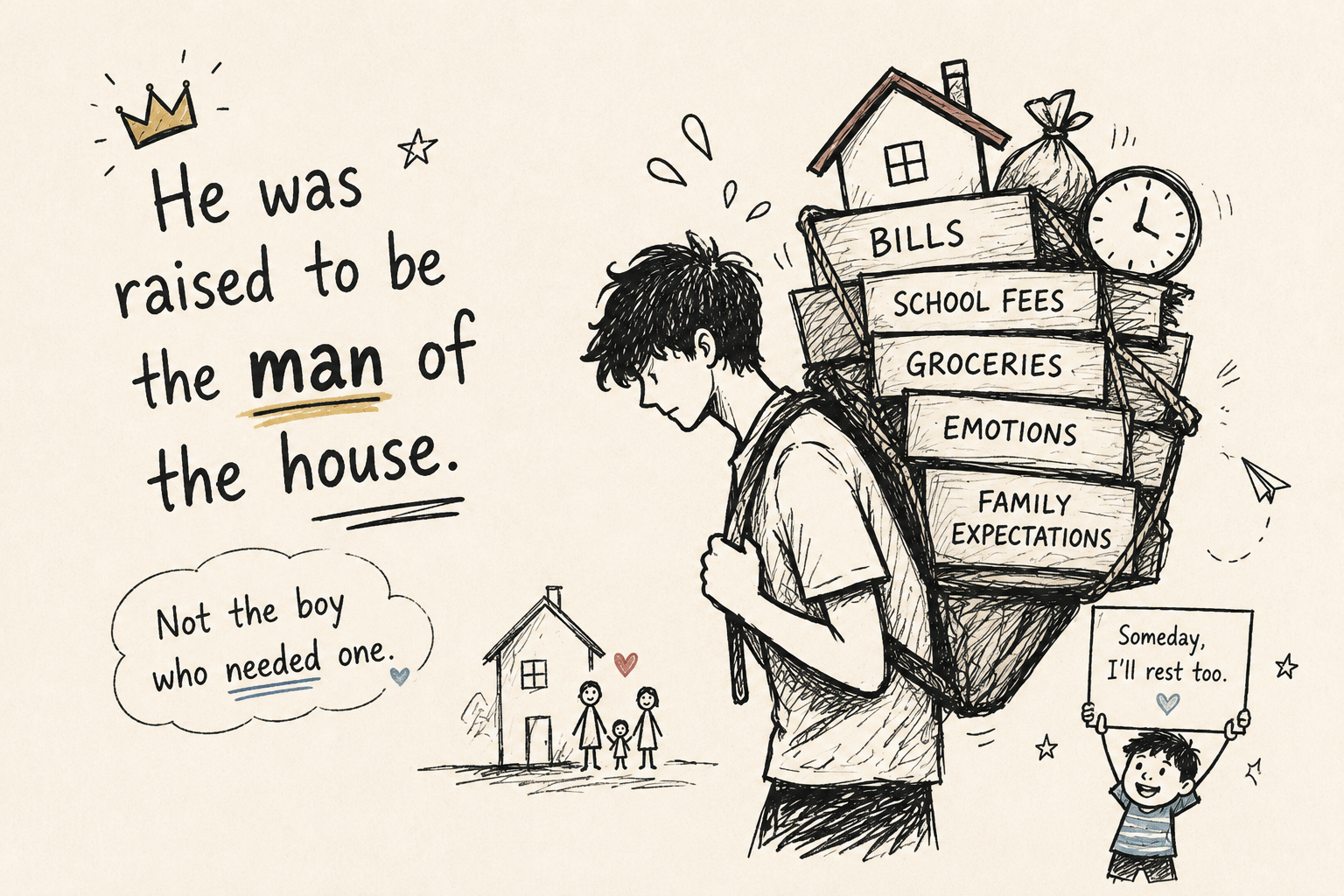
He Was Raised to Be “The Man of the House.”
Unfortunately, Nobody Raised Him to Be Human First.
Society has a magnificent talent for manufacturing emotionally bewildered men and then behaving absolutely stunned when they become difficult husbands, emotionally unavailable fathers, or walking stress balls with blood pressure issues at 32.
A baby boy is born and instantly treated like the family’s long-term investment plan. Relatives arrive with the same recycled prophecies: “He’ll carry the family name.” “He’ll become the man of the house.”
“He’ll take care of everyone.” Wonderful. The child hasn’t even developed kneecaps yet, but congratulations — the burden of generational expectations has already been gently placed upon his forehead like a cursed crown. Then begins the grand South Asian social experiment:
Raise the boy with unlimited freedom but zero emotional education. Protect his ego more carefully than his mental health. Never teach him household responsibility because “that’s women’s work.” Reward emotional suppression and call it masculinity. Treat basic decency like exceptional behavior. And after all this? People expect him to magically transform into a psychologically evolved, emotionally articulate, financially stable, domestically responsible husband with communication skills, patience, and conflict resolution abilities. Sir, This man was applauded for putting his own plate in the sink once in 2009. Please lower the expectations.
Men Are Not Born Emotionally Unavailable. They Are Manufactured That Way.
Sometimes society doesn’t teach boys how to handle emotions; it teaches them to hide them. From childhood, they may learn that crying is weakness, fear is embarrassing, and asking for help is dependence. “Be a man” can become code for: don’t complain, don’t break down, and deal with everything alone.
Later, society criticizes men for being emotionally unavailable, even though it trained them to say “I’m fine” instead of explaining what they feel. Research links traditional masculine norms—such as self-reliance and emotional control—with lower help-seeking and greater stigma around mental-health support.
The consequences can be serious. Men die by suicide at higher rates than women in many countries, and silence can make it harder to seek help during a crisis. The irony is obvious: we tell boys not to be emotional, then complain that grown men don’t communicate.
Emotional strength is not the absence of emotion. It is the ability to recognize feelings, express them, regulate them and ask for help when needed. A man who says, “I’m not okay,” is not failing at masculinity; he is being human.

Society’s Crash Course in Emotional Suppression
Boyhood is a strange little prison disguised as privilege. Little boys are taught suppression almost before they understand what emotions are. A boy falls and cries? “Stop behaving like a girl.” A boy gets frightened? “Be a man.” A teenage boy expresses vulnerability? “Focus on your career instead of emotions.” By adulthood, many men possess the emotional vocabulary of an unplugged microwave.
And society still has the audacity to wonder why men struggle to communicate their feelings. My brother in patriarchy… you trained him like this. From childhood, boys are taught that anger is masculine, silence is strength, and emotional openness is a software glitch. So they grow up translating sadness into irritation, fear into aggression, hurt into withdrawal, and vulnerability into silence. They learn to overwork instead of talk, disappear instead of explain, and stare at the ceiling fan at 2 a.m. wondering why nobody understands them. Then we call them “emotionally unavailable” as if they independently downloaded the problem. Sometimes, the man who struggles to express what he feels is simply the boy who was never taught that he was allowed to feel it.
Indian Parenting and the Rise of the Domesticated Prince
Let’s say this clearly. One of the biggest reasons marriages suffer is because many boys are raised without responsibility inside the home. Not because men are naturally incapable. But because parents intentionally excuse them from learning life skills. The daughter is taught: Cook. Clean. Adjust. Serve. The son is taught: Study. Earn. Sit.
By the age of 25, the man has a postgraduate degree, existential anxiety, and absolutely no idea where the cumin seeds are stored. Fascinating ecosystem. Then comes marriage. And suddenly the wife discovers her husband thinks “helping” means asking:
“Tell me what to do.”
Sir, respectfully… if you can operate stock market apps, fantasy cricket leagues, and cryptocurrency wallets, you can locate the laundry basket independently. This is not a participation certificate household. In the marriage relationship suddenly the woman feels like she adopted an exhausted corporate toddler. And the man feels attacked because nobody ever taught him partnership. This creates resentment from both sides.
The wife thinks:
“Why do I have to explain basic adulthood?”
The husband thinks:
“Why is everything I do wrong?”
And the parents?
Still proudly announcing:
“My son never had to do household work.”
Yes aunty. We noticed.
Teenage Boys: Confused Creatures Running on Ego and Chai
Teenage boys are honestly one motivational quote away from complete collapse. Society expects them to build a career, be masculine, stay confident, become financially successful, protect their family, and somehow never admit that they have absolutely no idea what they’re doing. Meanwhile, half of them are surviving on ₹30 momos, gym reels, rejection trauma, and “bro, she viewed my story.”
But beneath all that swagger, most teenage boys are far more insecure than they let on. Many aren’t naturally arrogant or emotionally distant—they’ve simply been taught that vulnerability is weakness. So they learn to overcompensate: fake confidence, fake toughness, fake dominance, and the legendary “I don’t care” attitude while very much caring.
Because from an early age, boys are often given the same message in different packaging: Don’t cry. Don’t look weak. Man up. Handle it yourself. Be a man. And eventually, they do.
They stop asking for help. They hide rejection behind jokes. They turn insecurity into attitude and sadness into anger. Not because they were born emotionally unavailable, but because somewhere along the way, society made emotional vulnerability feel like a liability.
Marriage: Where Generational Trauma Meets Customer Service Expectations
Marriage is where many men realize they were raised for authority… not partnership. Now the same man who was emotionally spoon-fed by his mother is expected to suddenly become, emotionally intelligent, communicative, supportive, independent, romantic, financially stable, and diplomatically neutral during family conflicts.
Beautiful fantasy. He stands trapped between: the mother who says, “My son changed after marriage,” and the wife who says, “You never emotionally support me.” At this point the man is internally loading like a 2007 Windows desktop. If he supports his wife too much: “he is so changed after marrige.” If he supports his parents: “Mama’s boy.” If he stays quiet: “Emotionally unavailable.” If he reacts: “disrespectful.”
No wonder so many married men suddenly develop mysterious interest in sitting silently inside parked cars for thirty minutes before entering the house.
The Hidden Cost of Male Privilege
Society Built The “Tough Man” — Then Complained When He Couldn’t Open Up Yes, men absolutely benefit from patriarchy in many ways. But here’s the uncomfortable part: the same system that gives men certain privileges also teaches them a very specific way of being a man. Lead. Provide. Protect. Succeed. Stay strong. Don’t complain. Don’t cry. Don’t look weak. And then, years later, everyone wonders why some men struggle to communicate their feelings.
Men are mocked for being broke, then mocked for working too much. They’re told to be strong when life gets difficult, but criticized for being emotionally unavailable when they actually follow that training. They’re expected to become sensitive, emotionally intelligent partners while being raised in environments that often taught them the exact opposite.
Basically, society handed men an emotional instruction manual with half the pages ripped out — and then acted surprised when they couldn’t figure out the relationship chapter.
The problem isn’t that men are incapable of emotions. It’s that many were never taught what to do with them. If boys grow up learning that vulnerability is weakness, anger is the only acceptable emotion, and asking for help is embarrassing, we can’t exactly expect them to magically become emotionally fluent adults. Society helped build the “tough man” and then complained when he became too tough to talk.
And maybe that’s where the conversation needs to change: not by excusing harmful behaviour, but by asking why we keep raising boys to suppress the very emotions we later expect men to communicate.
Criticism Men Face Constantly
Men are constantly being measured against contradictions they were never given a chance to escape. If he doesn’t earn enough, he is considered irresponsible; if he earns too much, he is accused of choosing money over his family. If he shows emotion, he is told he is weak or “too sensitive,” but if he keeps his emotions buried, he is called cold, distant, or incapable of communicating. Be confident, but don’t be dominant. Be strong, but don’t be intimidating. Take charge, but don’t control. Help at home, but apparently not so much that someone can joke that he is “wife-controlled.” Stay committed to the family, but somehow remain ambitious enough to provide more. Stay single and people wonder what is wrong with you; marry late and everyone starts calculating your age; marry early and suddenly everyone has an opinion about your maturity.
And beneath all these contradictions is something deeper: men are often expected to prove their worth through performance rather than simply being allowed to exist as human beings. Their value can quietly become tied to income, status, strength, responsibility, confidence, sacrifice, and the ability to absorb pressure without complaining. A man can spend years carrying responsibilities nobody notices, make sacrifices nobody asks about, and still be reduced to one brutally simple question at a family gathering: “Salary kitni hai?”
Honestly, at this point, a man could rescue three puppies from a burning building, carry his grandmother to safety, cook dinner for everyone, pay the electricity bill, emotionally support his partner, and still have some relative leaning forward with the seriousness of a Supreme Court hearing: “Accha sab theek hai… lekin kamata kitna hai?”
The real problem isn’t that men should never be questioned or held accountable. It is that society often gives them an endlessly moving target: be successful, but not obsessed with success; be emotional, but not vulnerable; be strong, but not controlling; provide, but don’t let providing define you; care, but don’t become dependent; lead, but don’t take up too much space. Eventually, the message becomes less about becoming a good human being and more about constantly proving that you qualify as a “good man.”
When Pain Becomes a Pattern
Many men are suffering. And many women are suffering because of wounded men who were never taught emotional maturity, accountability, or partnership. Both things can be true at the same time.
A man damaged by pressure can still damage a relationship. A man who was emotionally neglected as a child can grow into someone who emotionally neglects others. His pain may explain where his behaviour comes from, but it does not excuse the harm it causes.
And that is where the conversation becomes uncomfortable. We cannot simply blame men for failing at emotional connection when many were never taught how to build it in the first place. But we also cannot use that lack of emotional education as a permanent excuse for hurting others.
The cycle has to be broken somewhere. Society teaches boys to suppress, endure, provide, and “be a man,” then expects those same boys to grow into emotionally available husbands and fathers. When they struggle, everyone acts surprised.
Perhaps the real tragedy is not that men have emotions they cannot handle. It is that so many were taught to hide those emotions until hiding them became a personality. And eventually, what one generation was taught to suppress can become the very thing that damages the next.
Dear Gen-Z & Millennial Moms: Raising Sons, Not Future House Guests.
Before the final thoughts I want to mention that new generation of mothers who are finally breaking the ancient family tradition of raising boys like decorative furniture with career goals. You know, the moms teaching their sons: how to communicate without punching walls, how to locate the kitchen without Google Maps, how to wash one single plate without acting like a freedom fighter, and how “being a man” is not measured by how emotionally unavailable they can become. Honestly, the future looks promising.
Somewhere out there, a six-year-old boy is learning: emotions are not weakness,, household chores are not female-exclusive side quests, and wives are partners, not replacement of mothers with Wi-Fi. Beautiful character development.
May this generation produce emotionally intelligent men who say:
“I’ll cook tonight,” without expecting national awards for it. And may future daughters-in-law finally experience the rarest creature known to South Asian households: A man who knows where the onions are kept and a man who is emotionally intelligent.
Okay, So What Do We Do Now?
Here’s the good news: what happened happened. The emotional damage, outdated gender roles, terrible parenting advice, and the legendary “boys don’t cry” nonsense are now part of the past. We can understand where the problem came from without spending the next 50 years using it as an excuse. The goal isn’t to shame men for being raised this way; it’s to stop handing the same emotional baggage to the next generation and calling it masculinity.
Men, for starters, need to retire the idea that emotional maturity is some kind of premium subscription available only after marriage. Learn to communicate before your wife becomes your unpaid therapist. Say what you feel instead of expecting everyone around you to decode your silence like it’s a government intelligence file. Learn basic household skills, participate in parenting, apologize without adding a 14-minute explanation about why you were “technically right,” and understand that providing money is not the same thing as providing partnership. Strength isn’t pretending nothing affects you. Sometimes strength is admitting, “I handled that badly, and I need to do better.”
And society has homework too. Stop raising boys to believe that vulnerability is weakness, aggression is confidence, and responsibility automatically makes them emotionally mature. Teach boys empathy, emotional vocabulary, accountability, caregiving, boundaries, and basic relationship skills as seriously as we teach them mathematics and career ambition. Let fathers show affection. Let sons cry. Let men ask for help without turning it into a masculinity crisis. Most importantly, stop treating gender roles like ancient software that nobody dares uninstall because “that’s how it has always worked.” It hasn’t worked that well.
Men don’t need to become less masculine. They need a healthier definition of masculinity, one where strength can coexist with tenderness, leadership can coexist with partnership, and responsibility doesn’t mean carrying everything alone. The past can explain us. It doesn’t have to control us. So yes, society made some terrible emotional software. But congratulations, gentlemen—we finally have the update available. Install it.
Final Thoughts
Maybe the problem is not that men are naturally distant, irresponsible, emotionally unavailable, or incapable of understanding relationships. Maybe we keep diagnosing the adult without examining what was taught to the child.
For generations, many boys have been given an unusual assignment: become useful before you learn how to become human. Learn how to earn. Learn how to compete. Learn how to protect. Learn how to tolerate pain. Learn how to win. Learn how to provide. Learn how to “man up.” But somewhere between teaching a boy how to carry responsibility and teaching him how to carry his own emotions, the second lesson quietly disappeared.
He learns that love can become conditional on achievement: study well, make us proud; earn well, become successful; be strong, don’t embarrass us. He learns comparison before self-understanding. Another boy is taller, richer, smarter, stronger, more successful. Failure becomes humiliation rather than information. Vulnerability becomes something to hide rather than something to understand. Financial pressure arrives before emotional maturity. And relationship skills? Apparently those are supposed to download automatically after marriage.
Then we grow surprised when the adult struggles to communicate.
We expect a man to understand his partner’s emotions when nobody taught him how to identify his own. We expect him to share household responsibilities when he may have grown up watching women quietly perform them as an invisible part of life. We expect emotional intelligence from someone whose childhood definition of emotional regulation was often simply “control yourself.” And we wonder why some men confuse providing with loving, silence with strength, authority with respect, and emotional distance with independence.
That does not excuse bad behaviour. Understanding where a behaviour comes from is not the same as defending it. A difficult childhood does not give an adult permission to become someone else’s emotional burden. Men still need accountability. They still need to learn communication, empathy, responsibility, boundaries, domestic skills and healthy conflict. But accountability works better when we stop pretending these abilities magically appear with age.
Maybe boys don’t need to be raised to become less masculine. Maybe they need to be raised to become more complete human beings.
Teach them that anger is an emotion, not an identity. Teach them that sadness doesn’t reduce their worth. Teach them to apologize without feeling humiliated. Teach them to cook, clean, care and nurture without treating these things as a loss of status. Teach them that providing for a family is valuable, but being emotionally present is also a form of provision. Teach them that strength includes asking for help. Teach them that tenderness is not weakness. Teach them that accountability is not an attack on their masculinity. Teach them that another person’s independence does not diminish their own importance.
Because otherwise we create a strange kind of adult: highly trained to carry responsibility, poorly trained to carry emotion.
And eventually, that unfinished emotional education walks straight into relationships. A wife becomes the emotional translator. A partner becomes the therapist. A mother becomes the permanent caretaker. And the man himself may not even understand why everyone keeps telling him that he is distant when, from his perspective, he is simply doing what he was taught: show love through duty, solve problems instead of discussing feelings, and keep the difficult things inside.
That’s how emotional patterns become generational. A father who was never taught vulnerability may raise a son who doesn’t know how to express it. That son enters a relationship carrying the same silence. His partner experiences that silence as rejection. Their children grow up watching the pattern. Then twenty years later, everyone wonders why nobody knows how to talk.
Congratulations. We have successfully manufactured the problem and then blamed the finished product.
— Trending Talez



One Comment