AI Is Separating Busy Work From Valuable Work
Modern workplaces often reward visible activity. Employees attend meetings, send emails, update spreadsheets and prepare reports. Some of this work is essential. Some of it continues because nobody has questioned whether it is still necessary.
And some of it exists because cancelling a meeting would require another meeting.
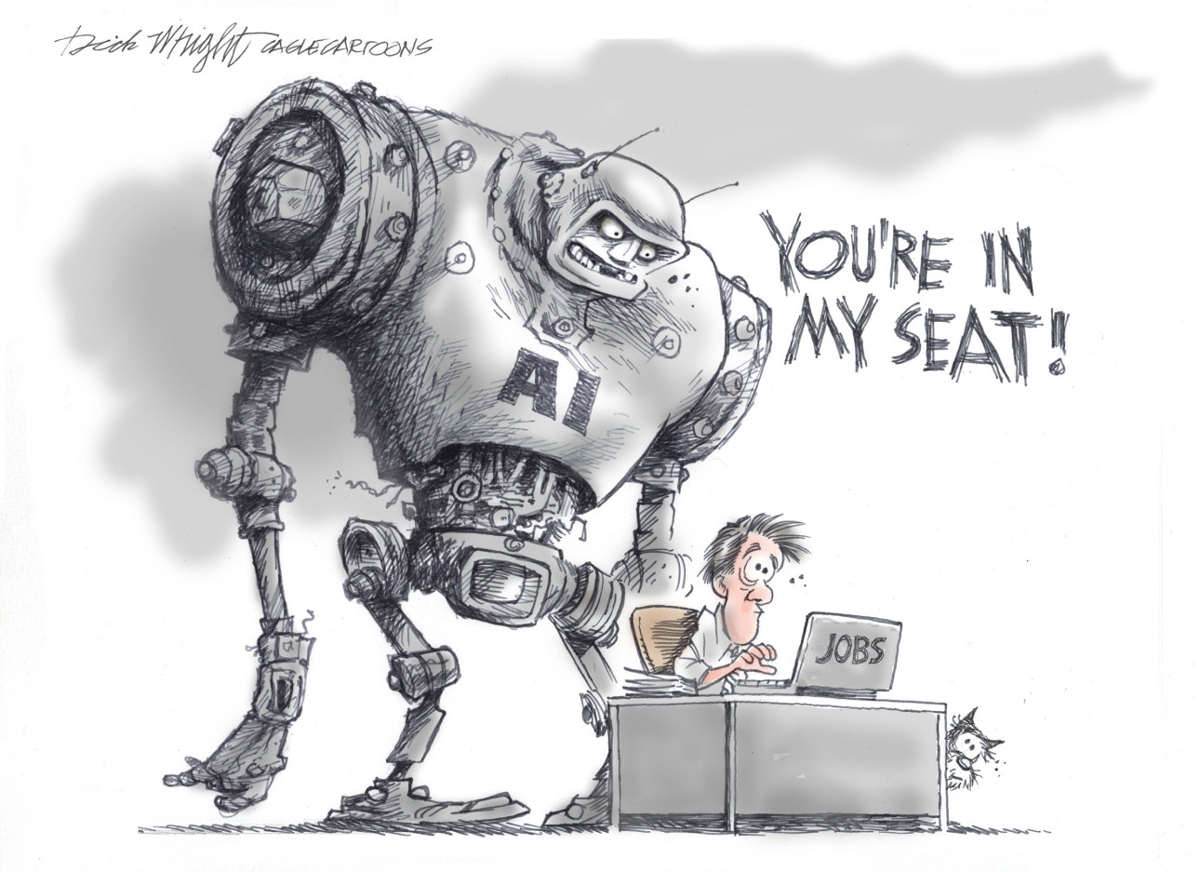
Artificial intelligence is forcing companies to ask that question. If a task previously took three hours but can now be completed in twenty minutes with AI assistance, the important question is not simply whether AI has taken three hours of work.
The more useful question is:
What should the employee do with the time saved by artificial intelligence?
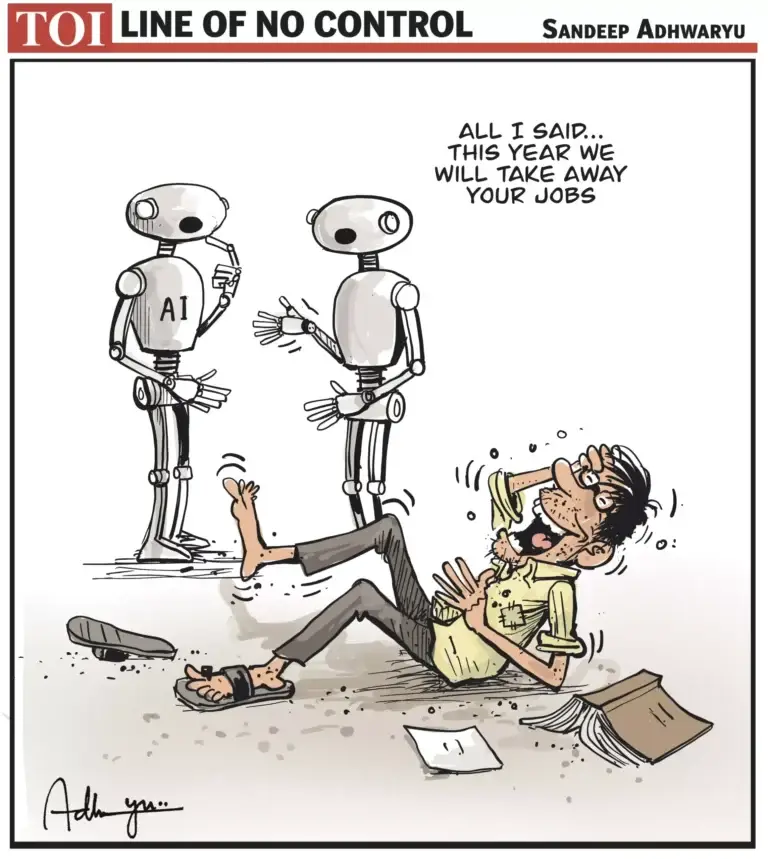
There are two possible outcomes. A company may use AI to reduce headcount and eliminate working hours. In that case, artificial intelligence functions primarily as a replacement technology.
Alternatively, a company may use AI to give employees more time for analysis, creativity, customer relationships, experimentation and strategic decision-making. In that case, AI becomes an augmentation tool.
The technology is the same, but the business decision is different. One company gets a more productive workforce. Another gets a smaller workforce and a suspiciously expensive subscription to twelve AI platforms nobody knows how to use.
AI is also becoming part of everyday life through recommendations, automated decisions, smart devices and personalised digital services. Learn more about that wider shift in our article on how artificial intelligence is already controlling your daily life.
Which Jobs Are Most at Risk From AI?
Jobs most exposed to artificial intelligence are not limited to factory work or manual labour. Generative AI can now write, summarise, translate, analyse, code, create images and process large amounts of information.
As a result, many office-based and knowledge-work roles are also experiencing increased exposure to automation. Apparently, the machines have finally discovered that office workers spend a surprising amount of time moving information from one box to another.
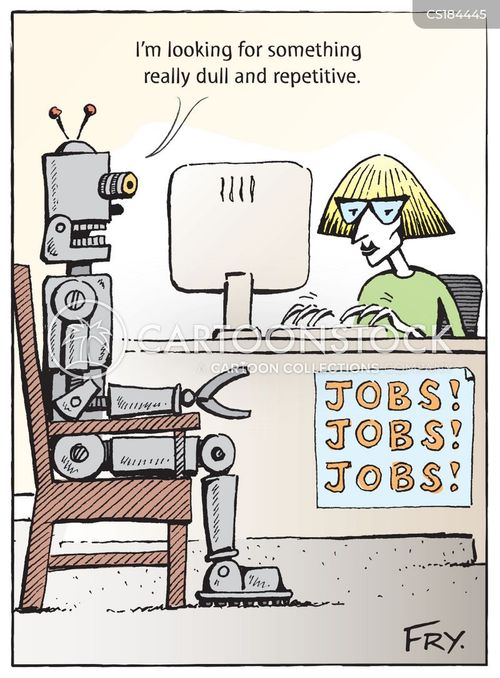
Clerical and administrative occupations are among the most exposed because they often involve structured information and repetitive processes. However, some professional and technical roles are also changing as AI tools become more capable.
This does not mean every accountant, writer, programmer, designer or analyst will lose their job. It means parts of their work are increasingly accessible to AI systems.
Workers may need to understand which tasks can be automated, which AI outputs require human review, how to identify inaccurate information, how to write effective AI instructions, how to interpret data, how to make decisions, how to communicate with customers and colleagues, how to solve problems without simple instructions and when to stop trusting a chatbot that is confidently inventing facts.
The valuable skill may shift from performing every task manually to understanding what should be automated, what should be checked and what still requires human judgment.
The future may reward people who know when to use AI, when not to use it and when to stop asking a chatbot questions it clearly cannot answer.
Why AI Will Not Replace Human Judgment
It is a mistake to assume that humans are automatically better than artificial intelligence at everything. People are slower at calculations, forget information, make mistakes and become tired.
AI systems can process large amounts of information quickly, generate multiple drafts and perform repetitive tasks without losing concentration.
Humans, meanwhile, can spend twenty minutes searching for a document that is open on the screen in front of them. So the competition is not entirely one-sided.
However, human value is not based only on intelligence or speed. Human workers provide context, judgment, accountability, empathy, relationships, creativity, ethical reasoning, strategic thinking and an understanding of goals.
An AI system can generate several business strategies, but a human still needs to decide which strategy fits the company’s goals, budget and customers.
AI can summarise customer complaints, but a human must determine what those complaints reveal about the brand.
Artificial intelligence can generate an answer, but someone still needs to decide whether the answer is accurate, appropriate and safe.
When an AI-generated answer causes a serious problem, “the algorithm did it” is unlikely to satisfy a customer, regulator or employer. It may not even satisfy the algorithm, although it will probably respond with confidence and a helpful-looking list.
How AI Can Expose Poor Management
Artificial intelligence does not only expose inefficient work. It can also expose inefficient organisations.
Consider a company where employees spend half their day preparing reports that nobody reads. If AI automates the reporting process, management faces a new question:
Why were employees spending so much time producing reports that had little value?
The problem may not have been employee performance. It may have been poor workflow design.
The same applies to companies that employ large teams to manually process information because “that is how it has always been done.” Once AI automates the process, the organisation may discover that the real problem was an outdated system rather than lazy employees.
This is one of the most important effects of AI automation. Artificial intelligence encourages companies to examine processes that survived for years because nobody had enough time, money or motivation to redesign them.
AI can act like a mirror. It shows organisations where work is repetitive, inefficient and disconnected from business value.
It also shows who has been scheduling meetings about improving the process instead of improving the process.
Can Good Workers Be Replaced by AI?
We should not pretend that only incompetent workers are vulnerable to artificial intelligence. That idea may be comforting, but it is not accurate.
A highly skilled employee can still lose part of their role if AI can perform certain tasks faster and more cheaply.
For example, a skilled translator may be affected by machine translation, a talented designer may see routine design work automated, an experienced programmer may use AI to generate code, a professional writer may use AI to create initial drafts, an analyst may automate data processing and reporting, and a consultant may discover that half of their “proprietary framework” was a colourful table with arrows.
Competence does not make a task impossible to automate. What matters is where a worker’s value comes from.
If an employee’s value comes mainly from executing predictable tasks, AI automation may threaten that part of the role.
If their value comes from judgment, creativity, leadership, problem-solving, specialist knowledge and relationships, AI may become a powerful productivity tool instead.
No job is completely guaranteed to remain unchanged. However, some types of value are more difficult for AI to replicate than others.
Being good at your job helps. Being good at tasks that no longer need to be performed manually helps considerably more.
The Future of Work May Reward AI Skills
Workers do not necessarily need to become artificial intelligence researchers or software engineers. Most employees do need to become more comfortable using AI tools in their industry.
Important AI-related workplace skills include using AI tools effectively, checking AI-generated information, automating repetitive workflows, analysing data, thinking critically, communicating clearly, solving unfamiliar problems, combining technical and human skills, understanding privacy and security risks, applying professional judgment and recognising when AI is producing polished nonsense.
The World Economic Forum expects technological skills to remain important while also highlighting human skills such as analytical thinking, creativity, resilience and collaboration.
The future of work may not be defined by humans versus AI. It may be defined by employees who know how to use AI versus employees who do not.
Employers may increasingly ask:
Can this person complete the task?
They may also ask:
Can this person use technology to complete the task more effectively?
That represents a major change in how companies evaluate productivity and talent.
It also means “I have never used AI because I prefer doing things properly” may eventually become less impressive than people think.
Especially if the person saying it still spends four hours formatting a report that could have been finished before lunch.
The Work Was Valuable. AI Just Made It Repetitive.
Before we celebrate AI for making a task obsolete, let’s give humans some credit. If someone spent years answering the same customer questions, preparing the same reports, checking the same documents or entering the same information into spreadsheets, that work still mattered. Repetition doesn’t make human effort worthless; it simply means humans were spending their limited time solving yesterday’s problems again and again. Now AI can take over some of that repetitive workload, not because the people doing it were useless, but because their time can finally be used for something new. Instead of spending six hours processing information, a worker can spend those hours figuring out what the information actually means. Instead of answering the same questions, they can solve the problems nobody has encountered before. Instead of maintaining an old process, they can design a better one. And that may be the most exciting part of AI and the future of work: when machines take care of more predictable problems, humans get more room to create new problems worth solving. Because apparently, after thousands of years of human innovation, our next achievement is discovering entirely new things to worry about—and then getting paid to solve them.
Will Artificial Intelligence Create New Jobs?
Artificial intelligence will eliminate some tasks and may reduce demand for certain roles. However, it is also likely to create new jobs and expand existing occupations.
New roles may develop around AI system management, AI safety, data analysis, automation design, AI training, digital transformation, cybersecurity, human-AI collaboration, technology governance, AI quality control, prompt design and workflow development.
The World Economic Forum’s Future of Jobs Report 2025 estimates that broader labour-market trends could create approximately 170 million jobs while displacing 92 million by 2030. That would produce a net increase of 78 million jobs.
These figures represent multiple forces affecting employment, not artificial intelligence alone. Technology, economic conditions, demographic changes, business restructuring and consumer behaviour all influence the future of work.
AI is one major force within a much larger transformation.
It may create new opportunities, although some of those opportunities will probably involve explaining to companies why their AI system has invented a statistic, misread a customer complaint and somehow recommended a competitor.
The Real Impact of AI on Employment
The biggest mistake is imagining employment as a fixed list of occupations that technology either preserves or deletes.
Work is constantly changing.
The printing press changed jobs. Factories changed jobs. Computers changed jobs. The internet changed jobs. Artificial intelligence is continuing that process at a faster pace, with considerably more marketing jargon.
Some jobs will disappear. Some will shrink. Some roles will be redesigned. Some new occupations will emerge. Many existing jobs will become hybrid roles in which humans and AI divide responsibilities.
The impact of artificial intelligence on employment will depend partly on how companies use the technology.
Businesses can use AI to reduce labour costs, or they can use it to improve productivity and give employees more time for higher-value work.
Government policy, education, worker training and corporate decision-making will also influence the outcome.
AI may be powerful, but it does not get to decide the future of work by itself. That responsibility remains with humans, which is either reassuring or deeply concerning depending on your experience with corporate leadership.
The same technology is also influencing how people shop, communicate, travel and make decisions outside the workplace. Our guide to how artificial intelligence is already controlling your daily life explores those everyday effects in more detail.
How Workers Can Prepare for AI Automation
Workers can prepare for AI-related changes by identifying which parts of their jobs are repetitive and which require human judgment.
Start by asking which tasks you perform repeatedly, which tasks an AI tool could complete, which tasks require context or accountability, which skills are becoming more valuable, how you can use AI to improve your productivity, how you can verify AI-generated information, what new responsibilities you could take on and which parts of your job exist only because nobody has updated the process since the last recession.
The goal is not to compete with artificial intelligence at tasks AI performs well. The goal is to develop skills that complement AI.
These may include strategic thinking, communication, leadership, creativity, relationship-building, ethical decision-making, complex problem-solving, industry expertise and the ability to explain complicated things without creating a 47-slide presentation.
Workers who understand both their industry and the capabilities of AI may be better positioned than those who rely only on traditional methods.
The phrase “traditional methods” may sound respectable, but sometimes it means manually copying information into a spreadsheet because nobody has questioned the process since 2007.
A basic understanding of machine learning can also help workers recognise what AI tools are good at, where they can fail and why human review remains important.
The Real Question Is Not “Will AI Take My Job?”
“Will AI take my job?” is an understandable question. It’s also the workplace equivalent of asking, “Am I doomed?” and then refreshing LinkedIn for emotional support. A more useful question is:
Which parts of my job can artificial intelligence perform, and what valuable work can I learn to do that AI cannot easily replace?
Because AI doesn’t need to fire you, pack your desk and send your office mug back to HR to change your career. It only needs to make some of the things you do faster, cheaper or completely unnecessary. Charming, isn’t it?
And that may be the most uncomfortable thing artificial intelligence is exposing. Not that humans are useless. Not that every job is doomed.
But that being busy and being valuable are two very different things.
If AI automates a task you have been performing for years, it doesn’t automatically mean you were a terrible employee. Congratulations, your ten years of experience were not wasted. You were simply extremely experienced at doing something a machine can now do before your coffee gets cold.
Your advantage, then, may not come from doing the same task faster than AI. It may come from everything you can do after AI has finished doing the boring part. Because if your entire professional identity depends on a task that can be automated, the problem isn’t necessarily that AI is coming for your job. It may simply be that your job has been waiting for an upgrade.
Conclusion: AI Is Changing Jobs, Not Simply Erasing Them
Yes. Some jobs will disappear. Some tasks will disappear. Some employees will discover that the “five-hour process” they were very proud of was actually three clicks and a spreadsheet. No. AI is not going to eliminate every human occupation and leave us all unemployed, staring at our laptops while a chatbot attends our performance reviews.
The more accurate answer is far less dramatic: artificial intelligence is changing the nature of work. It is automating repetitive tasks, changing what employers expect from employees and making certain skills more valuable than others.
AI may expose inefficient workers. But it can also expose inefficient systems, outdated processes and management decisions that somehow survived for years simply because nobody wanted to ask, “Why are we doing this?”
It may replace some roles, but it can also make employees more productive by removing repetitive work and giving them more time for things that actually require a human brain.
So, the future probably won’t belong to the person who proudly announces, “I work 12 hours a day.” Congratulations. So does a printer when someone forgets to turn it off. It may belong instead to people who know how to use artificial intelligence, apply human judgment, solve problems, learn new skills and figure out which tasks are worth doing in the first place.
Because “I have always done it this way” is becoming less of a professional strength and more of a warning sign. The real skill may be knowing how to work differently.
And perhaps that is the real lesson of AI. Artificial intelligence isn’t simply asking whether humans can compete with machines.
It’s asking whether humans can finally stop confusing being busy with being valuable before a chatbot has to explain the difference in a three-line summary, followed by five bullet points, a table and a downloadable action plan.
And yes, it will probably finish before you do.

widprhxrrmsxlljpjjrgmxgtuhweon
Thanks for your insightful contribution. I’ll be thinking about ‘widprhxrrmsxlljpjjrgmxgtuhweon’ for years.