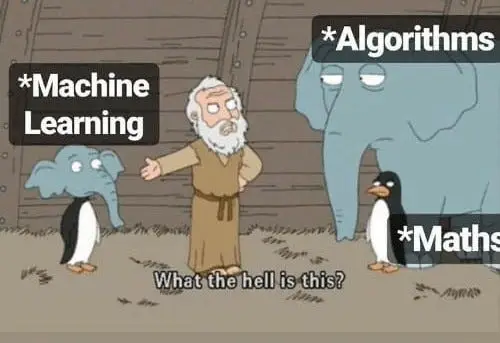
Machine Learning Explained for People Who Hate Math: How Machines Actually Learn
Because Numbers Are Scary, but Algorithms Are Already Judging You.
You watched one video about gym workouts, and suddenly YouTube has diagnosed you with a severe protein-powder dependency. You searched for one pair of shoes, and now every website on Earth has apparently formed a multinational task force dedicated to selling you sneakers. Netflix recommends a movie you were actually considering watching. Your email catches spam before you do. Your phone recognises your face while you’re still trying to negotiate with your reflection. And somewhere in the background, a tech person says:
“That’s machine learning.”
Wonderful!! Another phrase that sounds impressive enough to end a conversation while explaining absolutely nothing. Is the computer learning like a human? Does it understand what it’s doing? Does it stare at thousands of cat pictures until it suddenly whispers, “At last. The whiskers make sense”? No, Thankfully, computers haven’t developed that level of workplace drama yet.
Machine learning is a way of building computer systems that learn patterns from data and use those patterns to make predictions or decisions.
There is a frankly unreasonable amount of mathematics underneath it, but you don’t need to become a human calculator to understand the basic idea. This guide explains what machine learning is, how it works, the main types of machine learning, real-world examples, and where the mathematics enters the room wearing a tie.

What Is Machine Learning?
Machine learning is a branch of artificial intelligence that allows computers to learn patterns from data instead of being explicitly programmed with a separate rule for every possible situation.
Imagine you want a computer to identify spam emails. The old-fashioned approach would be to give it rules: if the email contains “FREE MONEY,” it is suspicious; if it contains 17 exclamation marks, it is extremely suspicious; if a Nigerian prince wants to transfer $4 million to you, it is definitely suspicious; and if the sender promises eternal wealth in exchange for your bank details, perhaps you should not click.
The problem is that the real world is annoyingly creative. Spammers change their wording, disguise links, imitate legitimate businesses and occasionally write emails that look as though they were assembled by a malfunctioning ransom-note generator.
Instead of manually writing thousands of rules, machine learning allows a system to learn patterns from examples. You give it lots of emails labelled Spam and Not spam. The model analyses those examples, identifies patterns that help distinguish between them and then makes a prediction when it receives a new email.
That’s the basic idea. No tiny robot brain required. No miniature professor in a server rack. Just data, algorithms and an alarming amount of computing power.
AI vs Machine Learning vs Deep LearningPeople often use AI, machine learning and deep learning as if they’re three names for the same thing. They’re related, but they’re not identical. Because apparently technology needed its own family tree.
Artificial Intelligence (AI) is the broad field concerned with creating systems capable of performing tasks associated with intelligence. Machine Learning (ML) is one approach used to build those systems by allowing them to learn patterns from data. Deep Learning is a type of machine learning that uses neural networks with many layers to learn increasingly complex patterns.
So, AI → Machine Learning → Deep Learning
AI is the big umbrella. Machine learning is one area underneath it. Deep learning is one approach within machine learning. Marketing departments, naturally, often throw these words around like confetti and hope nobody asks for definitions.ds—because they pay attention instead of interrupting.
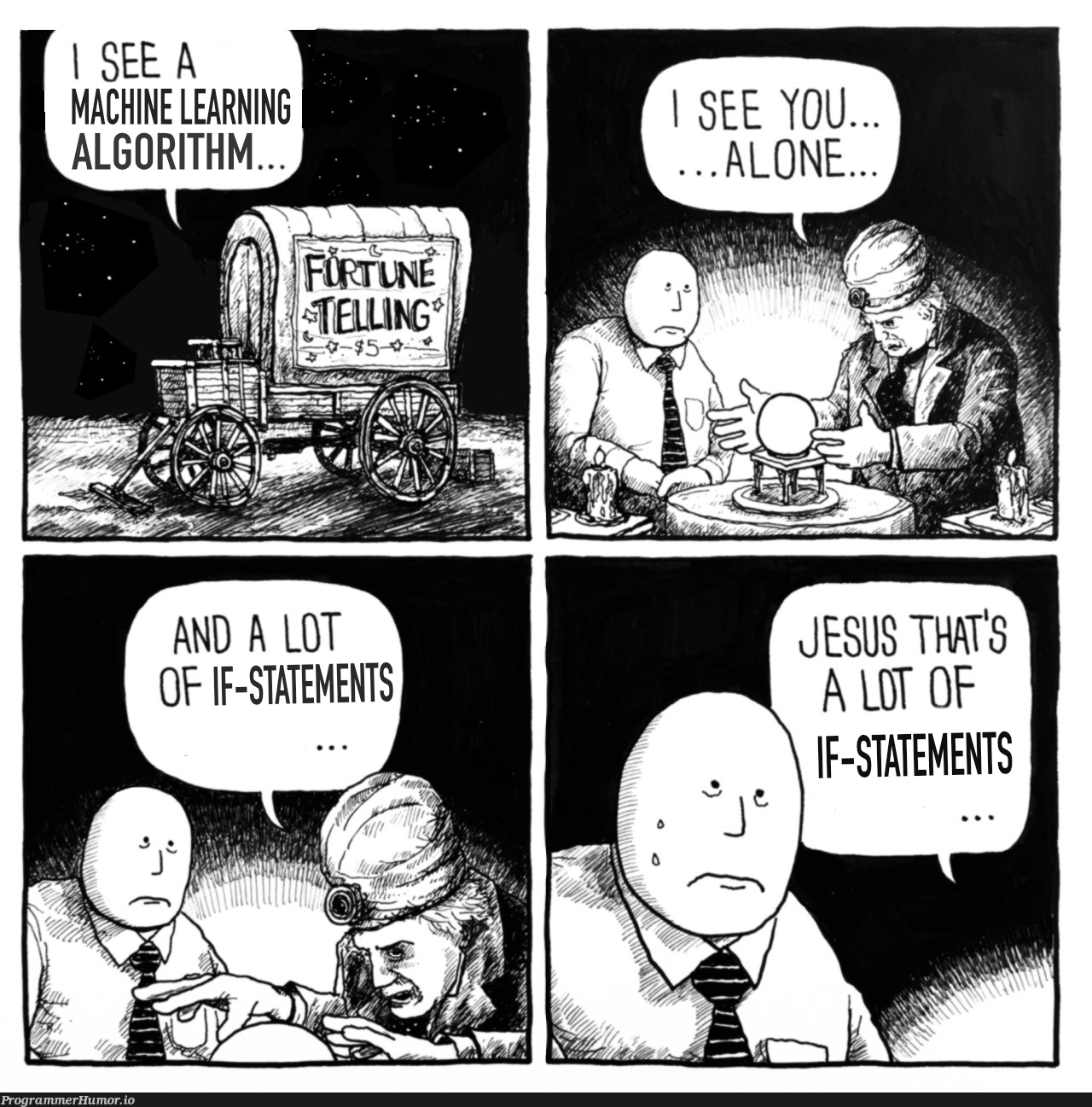
Traditional programming vs Machine learning
In traditional programming, humans explicitly define the rules:
Rules + Data → Output
For example:
If the temperature is above 30°C, turn the fan on.
The programmer writes the rule. The computer follows it. Everyone goes home feeling productive.
But imagine trying to write rules for recognising every possible cat photograph. You’d need rules for ears, eyes, fur, body shape, lighting, camera angles, colours, backgrounds, partially hidden cats, cats wearing costumes, cats pretending not to be cats and extremely judgmental cats. Good luck. Please submit your completed rulebook by Tuesday.
Machine learning flips the process around:
Data + Expected Answers → Learning Process → Model
Instead of manually writing every rule, you provide examples. The model discovers useful patterns from those examples. You don’t necessarily tell the computer exactly how to solve the problem. You give it data, define the objective and use a learning algorithm that adjusts the model based on its performance. And that brings us to the obvious question: How the hell does it actually learn?
How Does Machine Learning Actually Learn?
Machine learning generally works through a process of making predictions, measuring errors and adjusting internal parameters. In other words, the computer guesses, gets told how embarrassing the guess was, changes something internally and tries again.
Step 1: Give the model data
The model needs examples. For a spam detector, that could mean thousands or millions of emails. For an image-recognition system, it could mean huge collections of labelled images. For a recommendation system, it could include information about what users watched, clicked, searched for or purchased.
The data is the raw material. No useful data? The model has very little to learn from. Give it terrible data? Congratulations, you’ve built a very expensive machine for producing confident nonsense.
Step 2: Define the task
The model needs an objective. Are we trying to classify an email, predict a house price, recognise an image, recommend a movie, detect fraud or forecast demand?
The machine needs a job. Unfortunately, unlike humans, it cannot attend a three-hour meeting about “alignment,” nod thoughtfully and pretend that counts as productivity.
Step 3: The model makes a prediction
Initially, the model may be terrible. You give it an example and it makes a prediction. Maybe it’s correct. Maybe it’s spectacularly wrong. Maybe it identifies a toaster as a horse with the confidence of a senior executive presenting a completely unresearched strategy.
That’s okay. The model isn’t expected to be born knowing everything. Although, judging by some product launches, people occasionally expect exactly that.
Step 4: Compare the prediction with the actual answer
Suppose the model predicts:
“Not spam.”
But the email was actually spam. There’s an error.
Machine learning uses mathematical methods to measure this error, including concepts such as loss functions and error metrics. The important idea is simple:
The model needs a way to know how wrong it was.
Otherwise, it is just making random guesses with excellent branding.
Step 5: Adjust the model
The learning process changes the model’s internal parameters so that its future predictions can improve.
This happens repeatedly:
Predict → Measure error → Adjust → Predict again
And again. And again. And again, because apparently the first several million attempts were not enough.
Machine learning is basically the world’s most expensive version of:
“Okay, try again.”
A Simple Example: Teaching a Computer to Recognise Cats
Suppose you want to build a system that recognises cats in photographs. You collect thousands of images. Some contain cats. Some contain dogs, chairs, people, cars and the occasional object that looks suspiciously like a cat but is actually a blanket. You label each image.
During training, the model starts identifying patterns in the images. Early patterns might involve simple features such as edges or textures. More complex representations can combine these into shapes and structures. Eventually, the model can use these learned patterns to classify a new image.
You show it a photograph it has never seen before, and it might produce:
Cat: 94%
That doesn’t mean the computer looked at the picture and thought:
“Ah yes. A beautiful orange tabby. Excellent whisker structure. Strong attitude. Would probably knock a glass off a table for sport.”
It means the model’s learned parameters produced a prediction that the image strongly belongs to the category cat. That distinction matters.
Machine learning is fundamentally about learning statistical patterns that can be used to make predictions. It is not about the computer developing a personal appreciation for cats. Cats already have enough admirers.
Algorithm vs Model vs Parameters: What’s the Difference?
Now we’re entering the vocabulary section designed to make ordinary people feel as though they accidentally enrolled in a graduate programme.
An algorithm is the procedure used to learn from data. It determines how the model should adjust itself during training. Examples include linear regression, decision trees, support vector machines, gradient descent and neural-network training methods.
The model is the learned mathematical representation used to make predictions. It is what you use after training.
Parameters are internal values that the model learns from the training data. They influence the model’s predictions.
A rough analogy is that the algorithm is the recipe, the model is the finished dish and the parameters are the quantities of ingredients. It isn’t mathematically perfect, but it is considerably less terrifying than throwing equations at someone who came here specifically because they hate equations.
Also, unlike some recipes, machine-learning models can contain millions or billions of adjustable values. So perhaps don’t try cooking one.
Training Data vs Test Data: How Do We Know It Actually Learned?
What if the model simply memorises the training examples?
Congratulations. You have created the machine-learning equivalent of a student who memorises the answer key and then collapses when the teacher changes the questions.
That’s where training and test data come in. Training data is used to teach the model. Validation data can be used during development to tune the model and decide how it should be configured. Test data is kept separate and used to evaluate how well the trained system performs on previously unseen examples.
The real goal isn’t:
“Can the model remember the examples?”
It’s:
“Can the model learn useful patterns that work on new data?”
That’s called generalisation, and it is one of the most important ideas in machine learning.
A model that only works on the data it has already seen is not intelligent. It is a very expensive scrapbook.
What Is Overfitting in Machine Learning?
Overfitting happens when a model learns the training data too closely and fails to perform well on new, unseen data.
Think about a student who memorises every question from the practice paper.
Practice paper: 100/100
Actual exam: What language is this?
The model has learned the training examples extremely well, but it hasn’t learned patterns that generalise properly. Machine-learning practitioners use various techniques to reduce overfitting, depending on the model and problem.
The broader lesson is simple:
A model isn’t useful merely because it performs brilliantly on data it has already seen.
It needs to perform reasonably well when reality decides to stop cooperating, which reality does almost immediately.
The Three Main Types of Machine Learning
The three commonly discussed categories are supervised learning, unsupervised learning and reinforcement learning.
1. Supervised Learning
In supervised learning, the model learns from examples where the desired answer is already known.
| Label | |
|---|---|
| “Congratulations! You won…” | Spam |
| “Meeting at 10 AM tomorrow” | Not Spam |
| “Claim your FREE prize” | Spam |
The model learns the relationship between the input and the known output. Common applications include spam detection, image classification, fraud detection, house-price prediction and customer churn prediction.
Supervised learning is basically:
“Here are examples with answers. Figure out the pattern.”
It’s like giving a student a worksheet with the answer key attached, except the student is made of mathematics and cannot complain about the font.
2. Unsupervised Learning
In unsupervised learning, you give the system data without telling it exactly what the categories are. The model looks for structures, similarities or groups within the data.
For example, a company might have thousands of customers but no predefined customer categories. An unsupervised-learning method could identify groups of customers with similar behaviour.
Possible applications include customer segmentation, grouping similar documents, finding patterns in large datasets and detecting unusual behaviour.
It’s less:
“Here’s the answer.”
and more:
“Here’s a giant pile of data. Find something interesting.”
Which is still a better job description than half the internships on LinkedIn.
The danger, of course, is that the model may find patterns that are technically real but completely useless. Humans do this too, usually with astrology.
3. Reinforcement Learning
Reinforcement learning works differently. Instead of simply learning from labelled examples, an agent interacts with an environment, takes actions, receives rewards or penalties and learns strategies that can improve future outcomes.
A simplified loop looks like:
Action → Outcome → Reward/Penalty → Adjustment → New Action
Reinforcement learning has been used in game-playing systems, robotics, control systems and decision-making problems.
Imagine teaching a system to play a game. It makes a move, gets a good result and learns that the behaviour is valuable. It makes a terrible move and discovers another way to embarrass itself.
Over many interactions, the system can learn strategies that maximise its expected reward. This is essentially trial and error, except the trial-and-error student has no feelings, no weekend plans and potentially access to a data centre.
Classification vs Regression: What Is the Model Actually Predicting?
Another basic machine-learning distinction is between classification and regression.
Classification predicts a category, such as spam or not spam, fraud or legitimate, cat or dog, and disease or no disease. The output belongs to a category.
Regression predicts a numerical value, such as house price, sales amount, temperature or demand forecast.
So:
Classification = “Which category?”
Regression = “How much?”
That’s it. No need to summon a mathematics professor. They are busy turning a simple explanation into a 47-slide presentation.
Okay, But Where Does the Math Actually Come In?
Here is the part where we stop pretending.
Machine learning uses a lot of mathematics.
Common areas include statistics, probability, linear algebra, calculus and optimisation.
However, there’s a difference between understanding machine learning and building machine-learning systems professionally. You can understand how a recommendation system works without knowing every equation involved in optimisation. But if you want to become a machine-learning engineer, data scientist or ML researcher, mathematics becomes increasingly important.
Statistics helps with understanding data and uncertainty. Probability helps model uncertainty and predictions. Linear algebra is heavily used in many machine-learning and deep-learning computations. Calculus appears in optimisation and understanding how models are adjusted. Optimisation methods help find parameter values that improve model performance.
So the honest answer is:
You don’t need advanced mathematics to understand machine learning.
But if you’re going to build sophisticated machine-learning systems, mathematics will eventually knock on your door. Unlike most salespeople, it will not take the hint when you don’t answer. It will simply return with matrices.
Machine Learning Is Only as Good as Its Data
A powerful algorithm cannot magically turn terrible data into perfect intelligence. The quality of the training data matters enormously. Problems can include incorrect labels, missing information, biased datasets, duplicate data, outdated information, unrepresentative examples and measurement errors.
This is why people often use the phrase:
“Garbage in, garbage out.”
If the training data contains serious problems, the resulting model can learn those problems with impressive efficiency. For example, if a facial-recognition system is trained on data that doesn’t adequately represent the population it will encounter, its performance may differ across groups.
The algorithm isn’t automatically neutral just because it’s mathematical. Math doesn’t sprinkle fairy dust over bad data. It merely gives the bad data a more professional-looking spreadsheet.
What Happens When Machine Learning Gets It Wrong?
Machine-learning systems make mistakes. A model might classify something incorrectly, miss an important case, produce a false alarm, perform poorly on unusual examples or fail when conditions differ from its training data.
A false positive occurs when the model predicts something is present when it isn’t.
For example:
Legitimate email → classified as spam
A false negative occurs when the model fails to detect something that actually is present.
For example:
Fraudulent transaction → classified as legitimate
Which mistake matters more depends on the application. In spam detection, a false positive is annoying. In medical diagnosis or fraud detection, the consequences can be much more serious.
That’s why saying:
“The model is 95% accurate!”
doesn’t tell the entire story.
You need to know what it gets wrong, how often and where those errors happen.
A model can be 95% accurate and still be catastrophically bad at the one thing you actually hired it to do. Numbers are very good at looking reassuring while quietly avoiding the question.
Where Is Machine Learning Used in Real Life?
Machine learning is already embedded in a ridiculous amount of everyday software.
Recommendation systems
Netflix, YouTube, Spotify and online stores can use machine learning to predict what you might want to watch, listen to or buy. That explains why you watched one cooking video and now the algorithm has decided you’re apparently opening a restaurant tomorrow. You clicked one video about sourdough and suddenly the internet believes you own a linen apron.
Search engines
Machine learning can help search systems understand queries, rank information and identify useful results. It can also help decide which result you will click, which advertisement will follow you around for six weeks and whether your search for “why am I tired” should return medical advice or a mattress advertisement.
Spam detection
Email providers can use machine learning to identify suspicious messages. This is particularly useful because apparently “URGENT!!! CLAIM YOUR MILLION DOLLARS!!!” was not obvious enough for everyone.
Fraud detection
Financial systems can analyse transaction patterns and flag potentially fraudulent behaviour. The system may notice that your card was used in three countries within ten minutes while you were sitting at home eating cereal. Your bank calls this fraud detection. Your cereal calls it a normal Tuesday.
Image recognition
Machine learning can help systems classify and analyse images. It can identify objects, faces, scenes and medical features, although it may still occasionally confuse a dog with a mop if the lighting is feeling dramatic.
Voice recognition
Machine learning powers many modern speech-recognition systems. It can understand accents, background noise and different speaking styles, although it may still turn “send the report” into “send the rabbit” at the exact moment you are speaking to your manager.
Healthcare
Machine learning can be applied to medical-image analysis, prediction and research. This is one of the areas where accuracy, bias, privacy and human oversight matter rather more than whether the system can recommend a decent action movie.
Business forecasting
Companies can use machine learning for demand forecasting, customer analysis and predictive maintenance. In theory, this helps businesses prepare for the future. In practice, someone will still schedule a meeting to discuss why the forecast was wrong.
So no, machine learning isn’t just some futuristic technology sitting inside a secret laboratory. It’s already part of everyday life, quietly making decisions while everyone argues about whether a chatbot is conscious.
And this is where machine learning stops being some mysterious code goblin lurking in a server and starts meddling in your everyday decisions—from what you watch and search for to what you’re recommended, shown, and quietly nudged toward. If you want to see just how deeply AI has wormed its way into ordinary life, check out our breakdown of how artificial intelligence is controlling your life.
Is ChatGPT Machine Learning?Yes. Modern generative-AI systems are built using machine learning, particularly deep-learning techniques.
But machine learning and generative AI aren’t the same thing.
Machine learning is the broader field. Generative AI refers to systems designed to generate new content such as text, images, audio, video and code.
A generative-AI system can use machine learning to learn patterns from enormous amounts of training data and then generate new outputs based on those learned representations.
So if someone says:
“AI is just ChatGPT.”
No.
That’s like saying:
“Transportation is just my scooter.”
Your scooter is transportation. It is not the entire transportation industry. It is barely the entire transportation experience, especially uphill.
Does Machine Learning Actually Understand Anything?
Does a machine-learning model actually understand what it’s doing?
The answer depends heavily on what you mean by “understand,” which is convenient because humans have been arguing about that word for centuries.
Machine-learning systems can recognise incredibly complex patterns and perform tasks that look remarkably intelligent. But producing a successful prediction isn’t automatically the same thing as possessing human-like understanding.
A model can identify patterns without experiencing the world like a human does. For example, an image model can learn features associated with cats without ever experiencing the delightful reality of being ignored by one.
It doesn’t need to. Its job is prediction. It does not need a childhood, a favourite cat or unresolved feelings about a childhood cat. It needs parameters that produce useful outputs.
Capability and human-like understanding are not automatically the same thing.
A calculator can produce the correct answer without understanding arithmetic. A machine-learning model can produce a useful prediction without understanding the world in the way you do.
Although, to be fair, some humans also make predictions without understanding the world. They just call it posting online.
Machine Learning vs Human Learning
Humans and machine-learning systems can both learn from experience, but they don’t learn in exactly the same way.
| Humans | Machine Learning |
| Can often learn from relatively few examples | Many systems benefit from large amounts of data |
| Use broad real-world context | Performance depends heavily on data and model design |
| Can transfer knowledge between situations | Generalisation varies by model and task |
| Can learn continuously from everyday experience | Often requires specific training or updating processes |
| Combine perception, memory and reasoning in flexible ways | Capabilities depend on architecture and training |
Humans are messy. Machines are also messy.
The difference is that machines generally hide their mess inside millions or billions of parameters while humans hide theirs behind phrases like:
“Trust me, I have a feeling about this.”
Humans can learn from one embarrassing experience and avoid repeating it for decades. Machine-learning systems may need thousands of examples, carefully prepared data and a specialised training pipeline before they can learn the same lesson.
Then they may still recommend the wrong movie.
And once machines can recognise patterns, generate content, analyse information and make increasingly sophisticated predictions, the obvious question eventually arrives: what happens to the humans whose jobs involve doing those things? That’s where the bigger debate begins—is AI actually taking our jobs, or is the reality more complicated?
Machine Learning Myths We Need to Stop Repeating
Myth 1: Machine learning means computers think like humans
No. Machine-learning systems can perform sophisticated tasks without necessarily working through human-like thought processes. A system can recognise patterns, generate text or classify images without having a tiny human mind trapped inside a server.
Please stop imagining a miniature office worker in there. It has enough problems.
Myth 2: AI and machine learning are identical
No. Machine learning is a major approach within the broader field of AI.
Calling all AI “machine learning” is like calling every vehicle “a bicycle.” Technically, it gets you somewhere. Conceptually, it is doing a lot of damage.
Myth 3: More data automatically means a better model
Not necessarily. Bad, biased, irrelevant or poorly labelled data can still produce bad results. More data can simply mean more bad information delivered at industrial scale.
Myth 4: Machine learning doesn’t need humans
Humans still play major roles in collecting data, defining objectives, selecting models, evaluating performance, interpreting results and deploying systems.
The machines have not successfully eliminated us yet. Our emails remain unanswered. Our calendars remain full. Our meetings continue to multiply.
Myth 5: You need to be a mathematics genius to understand machine learning
You don’t. You need mathematics to go deeper into building and understanding ML systems technically, but the core concepts can be learned without drowning in equations.
You can understand what a car does without becoming a mechanical engineer. You can understand machine learning without personally deriving every formula that makes it work.
Myth 6: Machine learning always gives objective answers
No. Models learn from data created and collected in the real world, and that data can contain bias, errors and limitations.
A mathematical model can still produce a biased outcome. In fact, it can produce that biased outcome with decimal places, charts and a dashboard that makes everyone feel reassured.
Machine Learning in One Simple Diagram
If you remember absolutely nothing else from this article, remember this:
DATA → TRAINING → MODEL → NEW DATA → PREDICTION
Data: Examples the model learns from.
Training: The process of adjusting the model based on those examples.
Model: The learned system containing parameters that capture useful patterns.
New data: Something the model hasn’t necessarily seen before.
Prediction: The output produced by the model.
That’s the basic machine-learning story. Real systems can be vastly more complicated, but complexity shouldn’t prevent you from understanding the foundation.
At its simplest, machine learning is a very elaborate process of showing a computer examples, correcting it repeatedly and hoping it doesn’t become confidently wrong in a way that affects your mortgage application.
Do You Actually Need Math to Learn Machine Learning?
You can learn the conceptual foundations of machine learning without advanced mathematics, but your mathematical needs depend on what you want to do.
If you simply want to understand machine learning
Basic mathematics is enough to start. You need to understand ideas such as patterns, averages, probability and error. You do not need to personally wrestle a calculus textbook in a car park.
If you want to use machine-learning tools
A stronger understanding of statistics and data becomes useful. You should know what the model is doing, what its outputs mean and when it is confidently talking nonsense.
If you want to build machine-learning models
You’ll need programming, statistics and mathematical concepts. At this point, the equations may stop politely waiting outside and enter your house.
If you want to become an ML engineer or researcher
You will eventually need to become comfortable with more advanced mathematics. This is where linear algebra, calculus, probability and optimisation stop being optional background characters and start demanding dialogue. So don’t make the mistake of thinking:
“I hate math, therefore I can’t learn machine learning.”
That’s like saying: “I don’t understand engines, therefore I can’t drive a car.”
You can learn how something works before becoming qualified to rebuild it in your garage. Just don’t rebuild the machine-learning model in your garage. Your neighbours already have enough concerns.
Final Take: Machine Learning Isn’t Magic. It’s Pattern Recognition With a Lot of Math Behind the Curtain.
Machine learning sounds intimidating because the terminology makes it seem like computers are performing some mysterious act of digital wizardry. They’re not. At its foundation, machine learning is about using data to learn patterns that can help a system make predictions or decisions about new information.
The system receives data, makes predictions, measures its performance, adjusts its parameters and repeats the process until the results become useful—or until someone runs out of computing budget. Different machine-learning approaches handle different kinds of problems, from classification and regression to clustering and reinforcement learning.
And yes, there is serious mathematics underneath it all. But you don’t need to understand every equation to understand the central idea. The computer isn’t magically becoming human. It’s not sitting in a cubicle contemplating existence. It’s not secretly judging your Netflix choices. It’s learning patterns from data and using those patterns to make predictions. Which is impressive. Also slightly terrifying.
Because somewhere, right now, an algorithm probably knows you’re going to click on another video instead of finishing what you were supposed to do. It knows you will say, “Just one more.” It knows that “one more” means seven. And honestly? It’s probably right.


2 Comments