Quantum Computing Explained: Scientists Looked at Normal Computers and Said, “Not Confusing Enough”
First, What Even Is Quantum Physics? Before we understand Quantum Computing, we need to understand Quantum Physics.
And unfortunately, science couldn’t just call it “Tiny Stuff Physics.” That would’ve been too helpful. Quantum Physics is the branch of science that studies incredibly tiny particles like: atoms, electrons and photons.
Basically things so small that if they owed you money, you’d never find them. Scientists began studying these tiny particles and discovered something horrifying. The universe doesn’t make sense. At least not at tiny scales. Everything we learn growing up suggests the world follows rules.
Drop a ball. It falls.
Throw a stone. It moves.
Eat an entire pizza. Your jeans file a complaint.
Cause and effect.
Simple. Predictable. Reasonable.
Then scientists looked at tiny particles and discovered they behave like they were designed by a committee of sleep-deprived pranksters.
The Moment Science Became Weird
Imagine you leave your keys somewhere. Normally your keys are in one place. Maybe the table. Maybe your bag. Maybe the mysterious void where all lost objects go. But quantum particles apparently looked at this concept and said: “What if we’re everywhere until somebody checks?” Scientists discovered that tiny particles can exist in multiple possible states simultaneously. Which sounds like something a teenager would say after failing an exam.
“Technically I both studied and didn’t study.”
No.
That’s not how reality works. Except apparently it is. At least according to Quantum Physics. This discovery made scientists realize that the universe might actually be much stranger than anyone imagined. Which is impressive because scientists spend their lives imagining strange things.
Meet the Bit: The Tiny Worker Inside Your Computer.
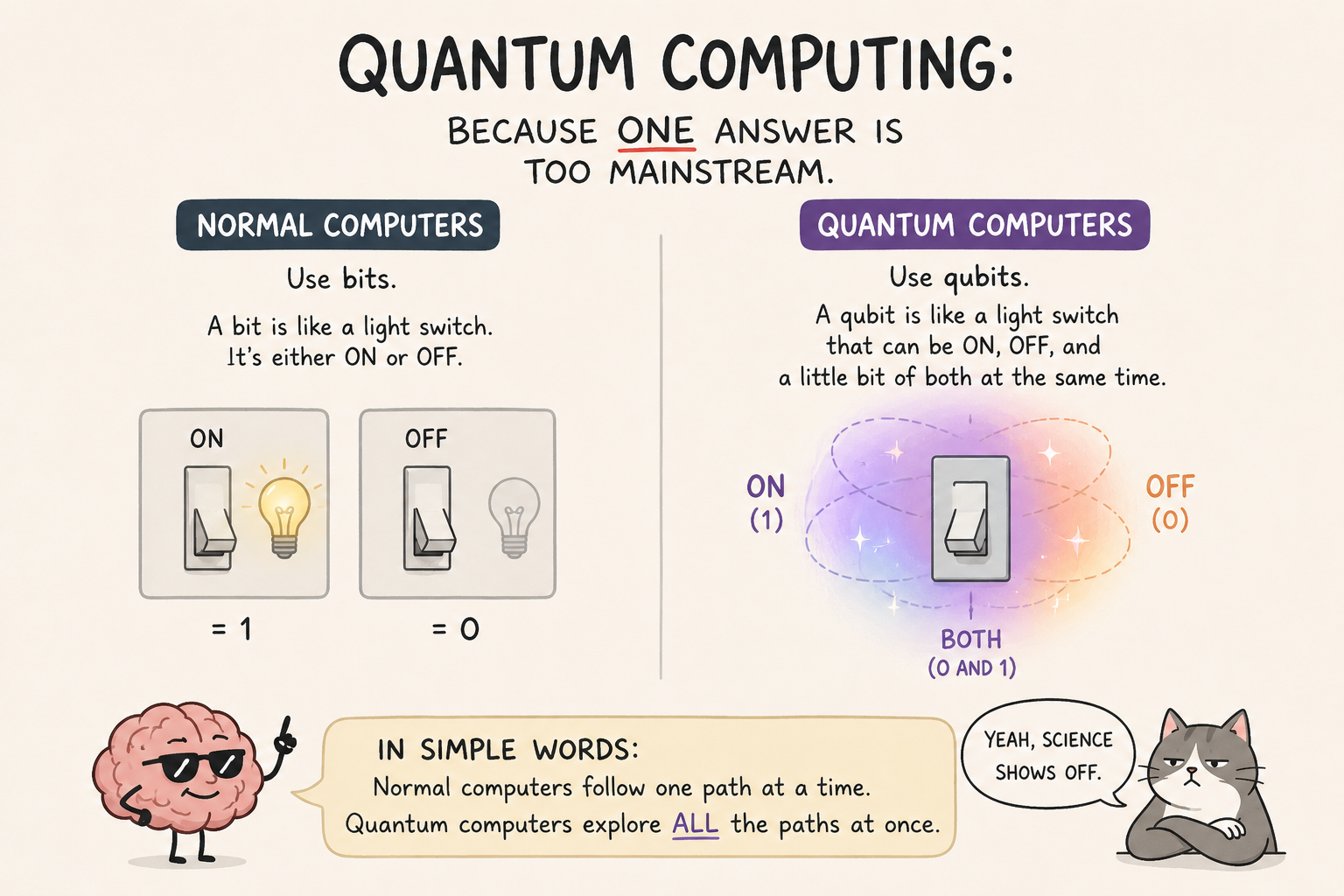
Before we talk about Quantum Computers, let’s understand normal computers. Your laptop. Your phone. Your gaming console. Your smart TV that’s somehow slower than technology from 2011. All of them work using something called a bit. A bit can only be one thing at a time:
-
- 0
-
- 1
Think of a light switch. It’s either: ON or OFF
Not both. Not maybe. Not “it’s complicated.” Just ON or OFF.
Every website, video, game, selfie, meme, and embarrassing text message is built using billions of these tiny bits. Simple system. Very effective. Humanity built the internet using basically an endless collection of electronic yeses and nos. Honestly that’s impressive.
Then Scientists Invented the Qubit Because Apparently Life Was Too Easy 
Quantum Computers don’t use bits. They use something called a qubit. A qubit can be:
-
- 0
-
- 1
-
- Both 0 and 1 simultaneously
At this point you’re probably thinking:
“That’s stupid.”
Congratulations.
You now understand how most people feel the first time they hear about quantum physics.
Yet somehow it’s true.
Scientists tested it.
Retested it.
Checked it again.
Reality stubbornly refused to become normal.
And thus the qubit was born.
Superposition: The Universe’s Favorite Plot Twist
The reason qubits can do this is because of something called Superposition. Don’t run away. This is actually simple. Imagine flipping a coin. When it’s sitting on a table it’s either:
Heads or Tails….easy …right?
But while it’s spinning through the air? You don’t really think of it as heads or tails yet. It’s somewhere in between. A qubit behaves similarly. Until scientists measure it, it can exist in multiple possible states. This weird condition is called Superposition. Science saw “choose one answer” and replied: “Nah. Let’s keep all the answers for now.”
Why Superposition Makes Quantum Computers Powerful?
Imagine you’re trapped in a giant maze. A normal computer tries one route.
Wrong? Try another. Wrong? Try another. Wrong? Cry quietly.
A Quantum Computer can explore many possibilities at once. It’s like sending a thousand versions of yourself into the maze simultaneously. One of them eventually finds the exit. Hopefully the competent version. This ability allows Quantum Computers to solve certain complex problems much faster than traditional computers. Not every problem. Just the really nasty ones that make ordinary computers sweat.
Entanglement: The Creepiest Relationship Ever
If Superposition wasn’t strange enough, Quantum Physics introduces another nightmare called Entanglement. Entanglement occurs when two particles become connected. Very connected. Uncomfortably connected. The kind of connected where changing one instantly affects the other. Even if they’re separated by huge distances. Scientists observed this and basically reacted with:

“What the actual physics is happening?” Even Einstein wasn’t thrilled. He called it “spooky action at a distance.” When Einstein starts using words like spooky, everybody should probably pay attention. Quantum Computers use entanglement to coordinate qubits and perform calculations more efficiently. Because apparently the universe enjoys creating concepts that sound like rejected Harry Potter spells.
So Why Are Billion-Dollar Companies Obsessed With Quantum Computing?
Simple. Because it could solve some ridiculous problems. Problems that would take ordinary computers years, decades, or even longer. Let’s look at a few examples.
1. Finding New Medicines Faster
Creating medicine is hard. Really hard. Scientists have to simulate incredibly complicated molecular interactions. Traditional computers struggle with this. Quantum Computers could eventually model these interactions much more accurately.
Meaning: Better medicines, Faster discoveries, More effective treatments
Which is considerably more useful than spending six hours deciding what to watch on Netflix.
2. Improving Artificial Intelligence
AI is already advancing at a speed that makes humans mildly nervous. Quantum Computing could potentially accelerate certain AI tasks even further. Imagine AI systems processing gigantic datasets faster than ever. Exciting…right?
Absolutely. Slightly terrifying? Also absolutely.
3. Solving Traffic Problems
Every city has traffic. Every city hates traffic. Yet somehow traffic survives. Quantum Computers excel at optimization problems. Meaning they can help determine:
-
- Faster routes
-
- Better delivery schedules
-
- Smarter transportation systems
Could Quantum Computing finally defeat traffic? Maybe. Though traffic has survived humanity’s best efforts for decades. It’s basically the final boss of civilization.
4. Understanding Climate Change
Climate systems are incredibly complicated. There are millions of interacting variables. Temperature. Wind. Oceans. Atmosphere. Human activity. And whatever mood the weather decides to have that day. Quantum Computers could help scientists create better climate models and predictions. Which would be nice because weather apps occasionally display confidence levels that reality clearly did not approve.
Can Quantum Computers Replace Your Laptop?
No. Your laptop is safe. Your smartphone is safe. Your gaming PC is safe. Quantum Computers are not replacements. They’re specialists. Think of it like this: A Formula 1 car is faster than your family car. But you’re not driving a Formula 1 car to buy vegetables. Same logic. Quantum Computers are designed for specific challenges. Traditional computers still dominate everyday tasks.
The Biggest Problem: Quantum Computers Are Drama Queens
Quantum Computers are powerful. They’re also absurdly sensitive. Heat can affect them. Vibrations can affect them. Electrical noise can affect them. Probably harsh criticism can affect them. Many Quantum Computers must operate at temperatures colder than outer space. Which sounds less like technology and more like a scientific hostage situation. Scientists spend enormous amounts of effort simply keeping qubits stable. The future of computing currently requires machinery that has the emotional resilience of wet tissue paper.

Are We Close to a Quantum Future?
Sort of. Researchers are making huge progress. But we’re still early. Think of Quantum Computing today like the internet in the 1990s. People knew it was important. People knew it was powerful. Nobody fully understood how much it would eventually change the world. That’s where Quantum Computing stands today. Promising. Powerful. Confusing. And occasionally sounding like a prank.
Final Thoughts: The Universe Needs Better Explanations
If there’s one thing Quantum Computing teaches us, it’s this: The universe is weird. Far weirder than we expected. Tiny particles can be in multiple states. They can become mysteriously connected. They can behave in ways that completely ignore common sense. Scientists discovered all this and instead of running away, they decided:
“You know what? Let’s build a computer out of that.” And somehow it’s working. Quantum Computing may transform medicine, AI, transportation, science, and technology over the coming decades. But perhaps its greatest achievement is proving that reality itself is far stranger than science fiction. Because somewhere deep inside the fabric of existence, tiny particles are breaking all the rules. And humanity looked at that chaos and said: Perfect. Let’s use it to run calculations.” Normal computers weren’t confusing enough, apparently.
I hope I’ve successfully helped translated Quantum Computing from “scientist language” into “normal human language.” And I hope Quantum Physics has stopped looking like a secret code written by caffeinated physicists at 3 AM. If you’re still confused, congratulations. You’re now experiencing Quantum Physics exactly as intended.
If Your Brain Hasn’t Quit Yet…
Wait until you discover:
- Cloud Computing — Humanity spent decades building computers and then decided storing them somewhere you can’t see was a fantastic idea.
- Machine Learning — Computers learning from experience while humans continue making the same mistakes repeatedly.
- AI in Everyday Life — The story of how your phone knows you’re hungry before you’ve even opened the food delivery app.
Apparently technology’s long-term strategy is becoming smarter while pretending it’s helping us.
“If your brain survived quantum physics without filing a resignation letter, congratulations. Drop your thoughts in the comments. And if you still don’t understand quantum computing, don’t worry some physicists aren’t entirely sure either.”




One Comment